AI estimate as of July 25, 2025 · verify with a professional before acting
AI-Generated · Verify before acting
Everything on this page is generated by AI for informational purposes only. AI can make mistakes — the AI may misidentify items or misattribute them (artist, maker, brand, designer, origin, era). This is not an official valuation and should not be used for insurance, sale, tax, estate, legal, or lending purposes — or any decision requiring a certified appraisal. It is not an authoritative claim about any person, brand, or rights holder — do not share or rely on it as a factual statement about a third party. Always consult qualified professionals before making financial decisions.
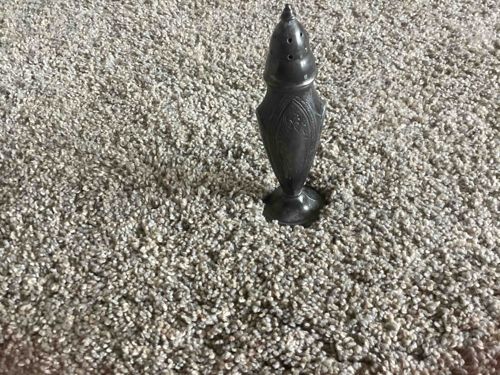
The item is an antique or vintage pepper shaker, typical of those found in dining sets. It appears to be constructed from a dark-toned metal, possibly pewter, Britannia metal, or a silver-plated base metal that has tarnished significantly. The surface exhibits a dull, matte finish consistent with age and oxidation. The shaker features a spire-like, tapered form, with a distinct wider, fluted body that narrows towards a circular base with a slight pedestal. The base itself seems robust, providing stability. Its most prominent decorative feature is a raised, relief design on the body, possibly depicting an embossed floral or foliate motif within a shield or cartouche-like frame, repeated symmetrically on opposing sides. The top section, which likely unscrews or lifts off for refilling, is perforated with multiple small holes, arranged in rows or a pattern for dispensing pepper. A sharp, pointed finial adorns the very top. The overall condition shows a heavy, even patina consistent with age and lack of recent polishing. There are no immediate visible signs of major damage like dents or cracks, suggesting good structural integrity for its age, although the exact material and manufacturing details would require closer inspection of any maker's marks, which are not visible in the provided image. The style suggests an late 19th to early 20th century aesthetic, possibly Victorian or Edwardian due to its ornate, almost Gothic-inspired design elements and the use of dark metal.
AI Appraisal Report
I have examined the provided image of this Antique Metal Pepper Shaker. Based on its appearance, it presents as a late 19th to early 20th-century piece, likely made of pewter, Britannia metal, or tarnished silver-plate, given the dark, matte patina. The tapered form, fluted body, and embossed floral/foliate motifs within a cartouche are consistent with Victorian or Edwardian aesthetics. The structural integrity appears good, with no overt dents or cracks visible, which is positive for an item of this age. The heavy, even patina strongly suggests authenticity rather than a modern reproduction attempting to mimic age. This is a common form of kitchenware/tableware, but its specific decorative elements and condition contribute to its appeal.
Market-wise, individual shakers, even antique ones, generally do not command high prices unless they are part of a rare set, exceptionally ornate, or linked to a significant maker. Comparables often sell in the $20-$60 range for similar standalone pieces. Demand for such items is moderate; collectors of antique kitchenware or specific metalware types would be interested. Its rarity is low to moderate, given the high production volume of such items during its probable era.
Factors impacting value include its age, apparent good condition (structurally), and decorative appeal. However, the lack of visible maker’s marks significantly limits its potential value, as an identified manufacturer could elevate its desirability. Its single status also reduces value compared to a complete set. My primary limitation in this appraisal is the reliance on images alone. I cannot definitively ascertain the exact metal composition, confirm authenticity beyond visual cues, or detect subtle damage without a physical inspection. An in-person examination would allow for closer inspection for maker's marks, assessment of the metal's weight and feel, and a more thorough condition report, including the functionality of the top section and the integrity of the perforations. Without provenance documentation, full authentication relies solely on visual assessment.