AI estimate as of October 6, 2025 · verify with a professional before acting
AI-Generated · Verify before acting
Everything on this page is generated by AI for informational purposes only. AI can make mistakes — the AI may misidentify items or misattribute them (artist, maker, brand, designer, origin, era). This is not an official valuation and should not be used for insurance, sale, tax, estate, legal, or lending purposes — or any decision requiring a certified appraisal. It is not an authoritative claim about any person, brand, or rights holder — do not share or rely on it as a factual statement about a third party. Always consult qualified professionals before making financial decisions.
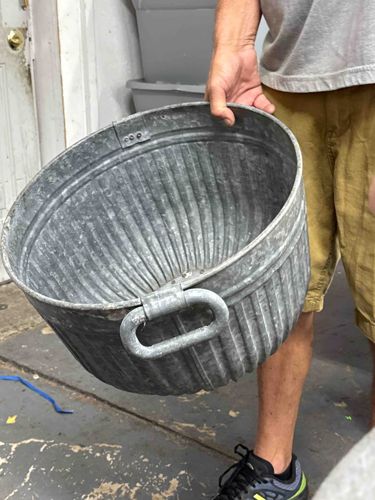
This item is a circular, galvanized metal tub, likely used historically as a wash tub or currently as a decorative planter. Its physical characteristics include a generally cylindrical shape with a slightly flared rim. The material is corrugated galvanized steel, evident from the distinct ribbed pattern horizontally around the body of the tub and its matte, mottled gray finish due to the zinc coating. The corrugation is deep and even, suggesting it was machine-formed for strength and rigidity. The tub features two robust, D-shaped handles attached to the side walls by riveted metal brackets. These handles appear to be made of the same galvanized metal, with their attachment points reinforced, allowing for carrying or hanging. The rim of the tub is rolled over, creating a smooth and secure edge, which is also reinforced with several small rivets visible around the top perimeter. The bottom of the tub is not clearly visible but appears to be flat. The overall condition shows signs of age and outdoor exposure, with a well-developed patina that includes areas of lighter and darker gray, some scuffs, and potentially superficial rust blooming through the galvanization in places, though no significant perforations or structural damage are immediately apparent. The visible craftsmanship indicates a utilitarian item, built for durability rather than intricate aesthetics, typical of late 19th to mid-20th-century functional metalware. No discernible maker's marks or signatures are visible in the provided image. Its estimated age could range from the early to mid-20th century, given the common use of such tubs during that period.
AI Appraisal Report
I have virtually examined this circular, galvanized metal tub, which presents as a quintessential utilitarian item from the early to mid-20th century, likely having served as a wash tub before its current or potential use as a planter. Its construction, characterized by deep corrugation, a rolled rim with visible rivets, and robust D-shaped handles attached with riveted brackets, confirms its authenticity as a period-appropriate piece of functional metalware. The material's matte, mottled gray finish and the well-developed patina, including expected scuffs and minor surface oxidation (rust blooming), are consistent with age and outdoor exposure, which is desirable for its aesthetic. There are no immediate signs of structural damage or significant perforations, suggesting good integrity for its age, though this is based on visual assessment alone.
In terms of market conditions, items like this fall into the 'vintage industrial' or 'farmhouse decor' categories. Comparables found in antique shops, online marketplaces (Etsy, eBay), and garden centers typically range from $30 to $100 depending on size, condition, and desirability of patina. This particular example, while lacking maker's marks that could increase value, is a solid, representative piece. Demand is consistent for such versatile items. Rarity is low; these were mass-produced. Factors impacting value positively are its robust construction and attractive, age-appropriate patina.
My assessment for authenticity and condition is based solely on the provided image. Limitations include the inability to check for hidden damage, assess the bottom's integrity or flatness, or determine if any repairs have been made. A physical inspection would allow for a tactile check of its structural soundness, confirmation of no significant hidden rust or holes, and measurement of its exact dimensions, which can influence pricing. Verifying provenance or seeking scientific testing wouldn't typically be necessary for an item of this nature and value, as its authenticity is largely self-evident from its design and material characteristics for a utility item.