AI Appraisal Estimate

AI-generated estimates · not official valuations

From the user

What was submitted

Photo and notes provided by the user — not generated by AI

Submitted item photo
Submitted photo · June 4, 2026

User's notes

Made in Italy

AI analysis below

AI appraisal

AI analysis & estimate

AI-Generated · Verify before acting

Everything below is generated by AI for informational purposes only. AI can make mistakes — the AI may misidentify items or misattribute them (artist, maker, brand, designer, origin, era). This is not an official valuation and should not be used for insurance, sale, tax, estate, legal, or lending purposes — or any decision requiring a certified appraisal. It is not an authoritative claim about any person, brand, or rights holder — do not share or rely on it as a factual statement about a third party. Always consult qualified professionals before making financial decisions.

Note

This analysis also relies on unverified notes provided by the user, which may be incomplete or inaccurate and could affect the result.

Read the full disclaimer

AI Identification

·Not independently authenticated·Verify before acting

Italian Ceramic Grape Motif Vase

Decorative Arts - Ceramics/Pottery

AI Estimated Value

·Not an official valuation·Verify before acting

$40-80

As of June 4, 2026

AI Item Analysis

·AI can make mistakes·Verify before acting
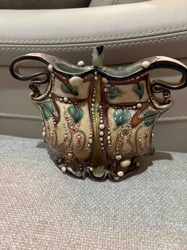
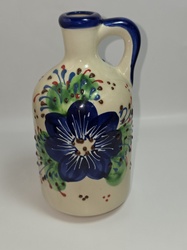
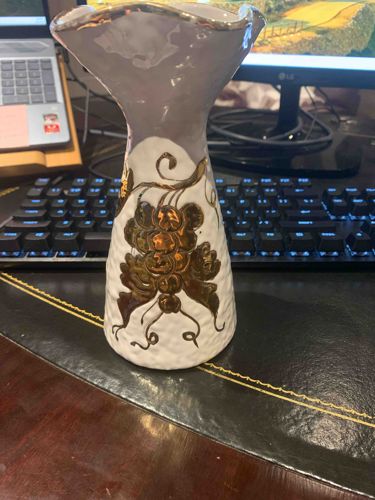
This is a decorative ceramic vase, likely made of earthenware or majolica, given the 'Made in Italy' context. It features a bulbous base that tapers upwards into a flared, ruffled rim. The vase is primarily colored in a two-tone scheme: the lower body and base appear to be an off-white or cream color, while the upper neck and rim are a light grey or lavender hue. A distinct gold or bronze metallic paint is used for the decorative elements. The most prominent decoration is a raised, textured motif of a grape cluster and vine leaves, applied to the cream-colored section of the body. This relief work suggests a hand-painted or hand-applied decoration technique, possibly with a raised enamel or slip. Further gold scrolls and flourishes extend from the main grape motif. The interior and exterior of the ruffled rim are also accented with the same metallic gold paint, showing some brushstrokes that indicate hand application. The surface has a glazed finish, providing a slight sheen. There are no immediately obvious chips, cracks, or significant losses to the glaze or paint visible in the image, suggesting good overall condition with typical minor wear commensurate with age and handling. The textured base and somewhat uneven application of the paint, particularly the gold, hint at artisanal craftsmanship rather than mass machine production. The style, especially the grape motif and the ruffled rim, points to a mid-20th century (e.g., 1950s-1970s) Italian decorative aesthetic, often associated with Tuscan or Venetian pottery styles.
AI Appraisal Report

·AI can make mistakes·Verify before acting
Upon visual examination of the Italian ceramic vase, I assess it to be a charming example of mid-20th century decorative pottery, likely from the 1950s-1970s. The 'Made in Italy' mark aligns with its stylistic characteristics, such as the grape cluster relief, ruffled rim, and hand-applied gold accents, all of which are typical of Tuscan or Venetian export ware from that era. The overall condition appears to be good, with no visible major chips or cracks in the provided imagery; the hand-painted nature is evident in the brushstrokes and slight irregularities, which are expected and contribute to its artisanal character. The current market for this type of decorative Italian ceramic is generally steady but modest. While well-made, these pieces were produced in significant quantities for the export market and are not considered rare. Comparable unsigned or general 'Made in Italy' marked vases of this size and style typically sell at auction or online marketplaces in the $40 to $80 range. The value is primarily driven by its decorative appeal rather than by a specific, highly sought-after maker. The lack of a specific maker's mark or artist's signature is the primary factor limiting its value. It is important to note that this appraisal is based solely on images. A physical inspection would be required to search for any impressed maker's marks under the base, assess for hairline cracks or repairs not visible in photos, and confirm the material composition. Full authentication would benefit from identifying a specific pottery or region of origin.

Get your items appraised

Instant estimates of your treasures with AI-powered appraisals

Browse More Appraisals