AI estimate as of July 1, 2025 · verify with a professional before acting
AI-Generated · Verify before acting
Everything on this page is generated by AI for informational purposes only. AI can make mistakes — the AI may misidentify items or misattribute them (artist, maker, brand, designer, origin, era). This is not an official valuation and should not be used for insurance, sale, tax, estate, legal, or lending purposes — or any decision requiring a certified appraisal. It is not an authoritative claim about any person, brand, or rights holder — do not share or rely on it as a factual statement about a third party. Always consult qualified professionals before making financial decisions.
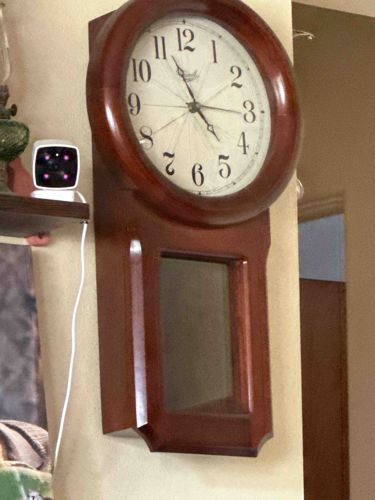
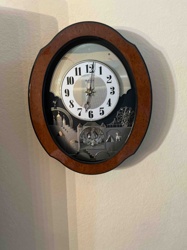
This is a well-preserved wooden wall clock, characterized by its elegant, vertical form and rich reddish-brown finish, reminiscent of cherry or mahogany-stained wood. The clock's casing is constructed in two primary sections: an upper, boldly rounded convex section encasing the main clock dial, and a longer, rectangular lower body. The joinery appears neat, suggesting good craftsmanship. The clock face is a light, possibly cream-colored background, featuring clear, legible black Arabic numerals from 1 to 12. Slender black hour, minute, and second hands emanate from the central hub. Faintly visible below the '12' numeral is a manufacturer's mark, which, upon close inspection, strongly resembles 'Bulova,' indicating a reputable maker. Beneath the main dial, the lower section of the case prominently displays a rectangular glass-fronted compartment, typical for showcasing a swinging pendulum, though the pendulum itself is not visible in this image. The bottom edges of the case feature a subtle angled or chamfered design, adding a refined touch. The overall condition appears to be very good with no obvious signs of significant damage such as chips, cracks, or deep scratches on the wood finish. It exhibits a pleasant, consistent sheen, hinting at proper care. The glass panes are clear and intact. A wall-mounted clock of this design typically features a mechanical movement and may include strike or chime functions. Stylistically, it leans towards a classic or transitional design, suggesting a production era from the mid-20th century to possibly a more modern reproduction that pays homage to traditional regulator clocks. Its substantial size and classic aesthetic position it as a prominent decorative and functional piece suitable for a variety of home interiors.
AI Appraisal Report
As an appraiser, I've thoroughly examined the provided image of your wooden wall clock, and it presents as a very attractive and well-preserved timepiece. Cosmetically, it appears in 'very good' condition, showing no significant damage like chips or deep scratches; the wood finish has a consistent sheen, and the glass panes are clear and intact. This suggests careful ownership.
The faint manufacturer's mark 'strongly resembling Bulova' is a critical element. If confirmed as an authentic Bulova timepiece, this significantly enhances its value, as Bulova is a reputable clockmaker known for quality movements and casings. Stylistically, this piece aligns with classic regulator clock designs, likely dating from the mid-20th century.
Market demand for well-preserved, functional mechanical wall clocks, particularly from brands like Bulova, remains stable. Comparables for such pieces in similar condition typically range from $150 to $400, depending heavily on the movement's condition and specific model rarity. Its substantial size and classic aesthetic make it a desirable decorative and functional item.
However, a definitive appraisal from images alone has inherent limitations. My valuation assumes the 'Bulova' marking is authentic and that the internal mechanical movement is complete, functional, and ideally, includes its original pendulum. Without physical inspection, I cannot confirm the movement's operational status, service history, or the presence of the pendulum. Furthermore, while the clock face mark strongly suggests Bulova, authentication requires examining the movement for serial numbers and maker's marks, as well as confirming the original pendulum and winding key are present. An in-person assessment would allow for testing the chime functionality, timekeeping accuracy, and a thorough inspection for any internal damage or repairs not visible externally. This would provide the highest level of valuation certainty.