AI estimate as of August 30, 2025 · verify with a professional before acting
AI-Generated · Verify before acting
Everything on this page is generated by AI for informational purposes only. AI can make mistakes — the AI may misidentify items or misattribute them (artist, maker, brand, designer, origin, era). This is not an official valuation and should not be used for insurance, sale, tax, estate, legal, or lending purposes — or any decision requiring a certified appraisal. It is not an authoritative claim about any person, brand, or rights holder — do not share or rely on it as a factual statement about a third party. Always consult qualified professionals before making financial decisions.
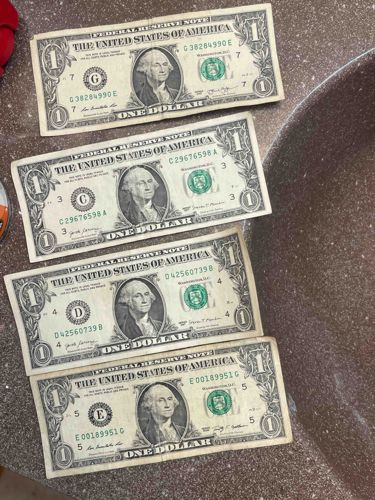
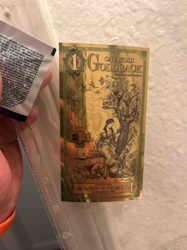
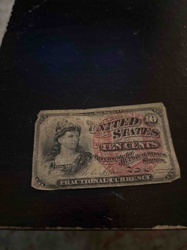
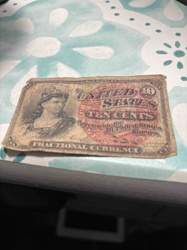
The image displays a group of four United States One Dollar Federal Reserve Notes. Each bill features a portrait of George Washington on the obverse, centered within an oval frame. To the left of the portrait, a large numeral '1' is present, along with the Federal Reserve District Seal, which varies by note (some show 'G', 'C', 'D', or 'E' indicating the district). To the right of the portrait is the Treasury Seal in green ink, and another large numeral '1'. The words 'THE UNITED STATES OF AMERICA' are printed prominently across the top, and 'ONE DOLLAR' is printed at the bottom. Each bill also includes a unique serial number, printed twice on the obverse in green ink (e.g., G 38284990 E, C 29676598 A, D 42560739 B, E 00189951 G). Signatures of the Secretary of the Treasury and the Treasurer of the United States are visible below the portrait. The paper currency appears to be made of a cotton and linen blend, typical for US banknotes, with a standard rectangular size. All four bills exhibit noticeable signs of circulation and wear, including folds, creases, and some discoloration or dirt accumulation, particularly along the edges and in the folds. There are no overt tears or significant damage visible, but the crispness and flatness of new bills are absent. The colors, primarily green and black on a cream background, are still vibrant enough to be easily readable, though some minor fading may be present due to age and use. Based on the design, these notes belong to the modern series of US currency, post-1963, given the size of the portrait and placement of design elements. The visible condition indicates they are well-used but still intact for exchange, suggesting an estimated age of several years of active circulation. There are no immediate visible signs of rare printing errors or unique distinguishing features that would significantly elevate their value beyond their face value, classifying them as common circulating currency.
AI Appraisal Report
I have examined the provided image of a lot of four United States One Dollar Federal Reserve Notes. My assessment is based solely on visual inspection, and I must preface this report by stating that a definitive appraisal, especially concerning authenticity beyond face value or the absence of subtle flaws, always requires in-person examination, including tactile inspection, light table viewing, and potentially micro-examination. While these notes appear authentic based on their design, printing, and general characteristics consistent with genuine U.S. currency, I cannot rule out sophisticated counterfeits or undetectable alterations from an image alone. Provenance documentation would also clarify their history.
Condition-wise, all four bills exhibit significant signs of circulation, including multiple folds, creases, and some degree of discoloration or dirt accumulation. They lack the crispness and flatness of uncirculated notes. While no major tears or extensive damage are immediately visible, their overall condition would be classified as 'Used' or 'Very Good' at best within numismatic grading standards, certainly not 'Fine' or higher. Such condition puts them firmly in the realm of common circulating currency.
Regarding market conditions, demand, and rarity, these are standard Federal Reserve Notes with no apparent errors, unusual series, or particularly rare signatures. The visible serial numbers do not suggest any 'fancy' serial numbers (e.g., solid numbers, low numbers, or repeaters) that would increase their value. Therefore, their value is essentially tied to their face value. While a collector might pay a very slight premium for older series in much better condition, these well-circulated notes hold no premium.
In conclusion, without any distinguishing rare features or exceptional condition, the value of these four United States One Dollar Federal Reserve Notes is their collective face value.