Lobed Blue and White Porcelain Narcissus Basin
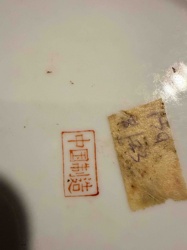
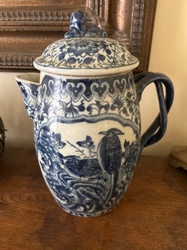
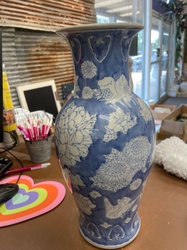
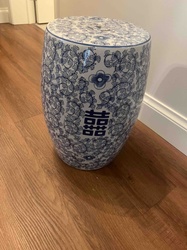
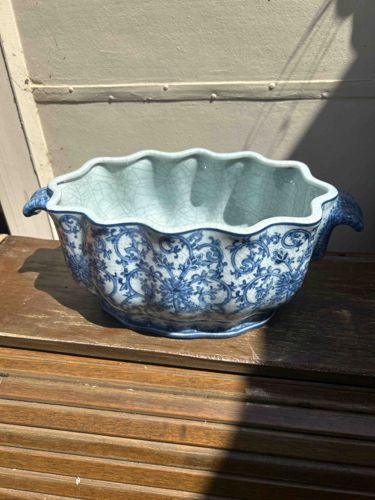
This is a substantial porcelain planter or bulb basin, commonly referred to as a Narcissus basin, featuring a distinctive lobed or fluted body. The exterior is decorated in a traditional Chinese underglaze blue and white palette with an intricate, repeating 'Lotus Scroll' or floral tendril pattern. The vessel has a scalloped or undulating rim and is flanked by two stylized handles that appear to be Integrated into the mold. The interior of the basin showcases a pale celadon-toned glaze with a prominent 'crackled' or 'ge' style crazing, indicating a deliberate decorative finish meant to emulate antique Song dynasty wares. The construction appears sturdy with thick porcelain walls. The condition appears fair to good for a decorative piece, though the heavy crazing is structural to the glaze layer. The style is 20th-century Asian export, likely imitating Qing dynasty (Qianlong period) floral motifs. The quality of the transfer or hand-painting shows some blurring, which is common in mid-to-late 20th-century reproductions. No maker's marks are visible from this angle, but such items often bear apocryphal reign marks on the base.
AI-Generated Appraisal Disclaimer
Estimated Value
$150 - $300
Basic Information
Category
Antique & Vintage Ceramics / Asian Export Porcelain
Appraised On
February 23, 2026
Estimated Value
$150 - $300
Item Description
This is a substantial porcelain planter or bulb basin, commonly referred to as a Narcissus basin, featuring a distinctive lobed or fluted body. The exterior is decorated in a traditional Chinese underglaze blue and white palette with an intricate, repeating 'Lotus Scroll' or floral tendril pattern. The vessel has a scalloped or undulating rim and is flanked by two stylized handles that appear to be Integrated into the mold. The interior of the basin showcases a pale celadon-toned glaze with a prominent 'crackled' or 'ge' style crazing, indicating a deliberate decorative finish meant to emulate antique Song dynasty wares. The construction appears sturdy with thick porcelain walls. The condition appears fair to good for a decorative piece, though the heavy crazing is structural to the glaze layer. The style is 20th-century Asian export, likely imitating Qing dynasty (Qianlong period) floral motifs. The quality of the transfer or hand-painting shows some blurring, which is common in mid-to-late 20th-century reproductions. No maker's marks are visible from this angle, but such items often bear apocryphal reign marks on the base.
Get Your Items Appraised
Instant estimates of your treasures with AI-powered instant appraisals