AI Appraisal Estimate

AI-generated estimates · not official valuations

From the user

What was submitted

Photo and notes provided by the user — not generated by AI

Submitted item photo
Submitted photo · June 8, 2026

User's notes

General Electric

AI analysis below

AI appraisal

AI analysis & estimate

AI-Generated · Verify before acting

Everything below is generated by AI for informational purposes only. AI can make mistakes — the AI may misidentify items or misattribute them (artist, maker, brand, designer, origin, era). This is not an official valuation and should not be used for insurance, sale, tax, estate, legal, or lending purposes — or any decision requiring a certified appraisal. It is not an authoritative claim about any person, brand, or rights holder — do not share or rely on it as a factual statement about a third party. Always consult qualified professionals before making financial decisions.

Note

This analysis also relies on unverified notes provided by the user, which may be incomplete or inaccurate and could affect the result.

Read the full disclaimer

AI Identification

·Not independently authenticated·Verify before acting

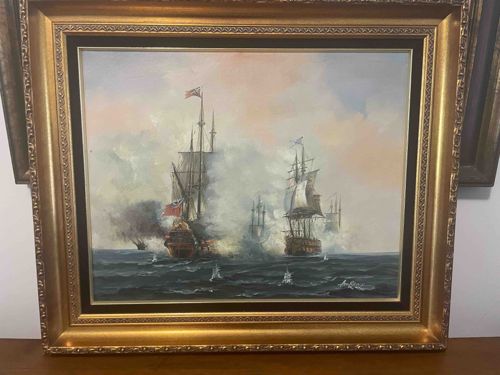
Late 20th Century Maritime Naval Battle Oil Painting

Fine Art - Painting

AI Estimated Value

·Not an official valuation·Verify before acting

$1,200 - $1,850

As of June 8, 2026

AI Item Analysis

·AI can make mistakes·Verify before acting
A striking oil painting on canvas depicting a dramatic 18th-century style naval engagement at sea. The composition features multiple three-masted ships of the line amidst plumes of white cannon smoke, with a central vessel flying a red ensign and a white flag with a blue cross (indicative of historical British or Scottish naval flags). The sea is rendered in deep indigo and grey-greens with white-capped swells, while the sky utilizes a soft pastel palette of peach, pink, and ivory, suggesting a dawn or dusk setting. The brushwork is impressionistic yet detailed in the rigging and hulls. The painting is housed in a contemporary, heavy-molded composite frame with a vibrant gold-gilt finish, featuring a tiered design with ornate beading and a dark navy blue or black inner wooden liner that serves as a visual fillet. The overall condition appears excellent with no visible surface cracking, paint loss, or foxing on the canvas. The frame shows minor signs of shelf wear but remains structurally sound. The style is reminiscent of traditional marine artists like Ivan Aivazovsky, though likely produced in the late 20th century as a decorative fine art piece. A signature is present in the lower right corner, though it is stylized and difficult to attribute to a specific listed master without further provenance.


AI Appraisal Report

·AI can make mistakes·Verify before acting
I have conducted a visual examination of the late 20th-century maritime oil painting. The work depicts an 18th-century naval engagement, executed with a high degree of technical proficiency in an impressionistic style. The canvas displays excellent tension with no signs of craquelure, paint loss, or oxidation, while the contemporary tiered gilt frame provides significant 'wall power' despite minor shelf wear. Based on the stylistic cues and canvas appearance, this piece is a decorative fine art production, likely created for the high-end interior design market rather than a 19th-century original. The market for large-scale maritime scenes remains stable, with demand driven by the subject matter's perennial appeal in corporate and traditional residential settings. Comparable sales for unsigned or minor-listed late 20th-century marine oils of this scale typically fall within the $1,000 to $2,000 range. The value is boosted by the quality of the ornate frame and the dramatic use of light in the sky. However, visual inspection alone cannot confirm the artist's identity or the exact age of the materials. To provide a definitive valuation of 'Fine Art' over 'Decorative Art,' a physical inspection is required to examine the canvas reverse for age-appropriate patina and to verify the signature against catalogs raisonnés. Provenance documentation from the previous owner (General Electric) would further bolster the appraisal by establishing a clear chain of custody. Without a forensic examination of the pigments and canvas weave, this must be valued as a high-quality contemporary decorative work.

Get your items appraised

Instant estimates of your treasures with AI-powered appraisals

Browse More Appraisals