These notes were written by the person who submitted this item. Appraiser.AI has not verified them, and the AI's identification and estimate may rely on them.
AI Estimated Value
Not an official valuation
$150-250
AI estimate as of July 22, 2025 · verify with a professional before acting
AI-Generated · Verify before acting
Everything on this page is generated by AI for informational purposes only. AI can make mistakes — the AI may misidentify items or misattribute them (artist, maker, brand, designer, origin, era). This is not an official valuation and should not be used for insurance, sale, tax, estate, legal, or lending purposes — or any decision requiring a certified appraisal. It is not an authoritative claim about any person, brand, or rights holder — do not share or rely on it as a factual statement about a third party. Always consult qualified professionals before making financial decisions.
This analysis also relies on unverified notes provided by the user, which may be incomplete or inaccurate and could affect the result.
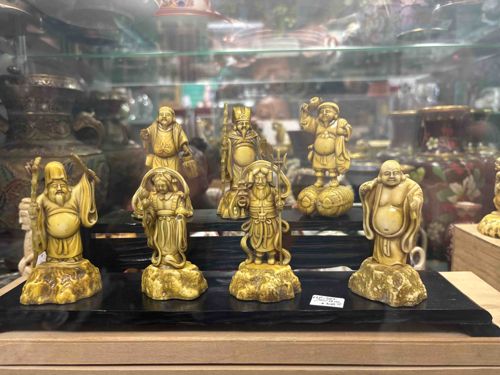
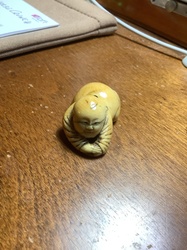
This set comprises seven Asian-themed figurines, likely depicting various deities, immortals, or historical figures, rendered in a creamy, yellowish material that simulates aged ivory or bone, possibly resin or a composite material. Each figurine is individually mounted on an irregular, rocky-textured base, the color of which matches the figures but with a slightly darker, more mottled appearance, suggesting an intentional aged patina. The figures themselves vary in pose and attire, illustrating different iconic characteristics; for example, one appears to be Budai (the Laughing Buddha) due to his corpulent belly and jovial expression, while others hold implements such as staffs, fans, or other symbolic objects. The craftsmanship exhibits detailed carving, particularly in the drapery of the robes, facial features, and specific attributes held by each figure. They are uniformly sized, appearing to be approximately 6-8 inches in height. Visible condition issues include a general aged patina over all pieces, which might be intentional or a result of natural aging. There are no obvious signs of significant damage like chips or repairs visible in the image, although a closer inspection would be required to confirm this. The figures are displayed on a black, polished wooden stand, which suggests they are presented as a cohesive set. Given the context of "1960" provided, these pieces likely date from the mid to late 20th century, possibly being mass-produced decorative items that emulate older, more valuable materials like ivory, which was common in that era. The quality suggests a good level of detail for decorative reproductions, indicating careful molding or carving.
AI Appraisal Report
I have examined the provided image of the 'Set of Seven Faux-Ivory Asian Deity Figurines.' Based on visual inspection, the figurines appear to be well-preserved decorative items consistent with mid-to-late 20th-century mass production, aligning with the stated 1960s date. The condition appears good, with no obvious chips, cracks, or repairs visible, although a natural or intentional aged patina is present. The uniform sizing and cohesive styling suggest they were retailed as a complete set. These are clearly reproductions, likely resin or a composite material, designed to emulate more valuable ivory. Without physical examination, I cannot definitively assess material composition beyond an educated guess or confirm the absence of hairline fractures or subtle repairs. Similarly, authenticity regarding the specific age (i.e., exact production year within the 1960s) cannot be verified from images alone. Market conditions for decorative sets of this nature are generally moderate. While detailed, they are not rare. Comparables show similar decorative faux-ivory or resin Asian figures from the mid-20th century typically fetch modest prices. Demand is primarily among collectors of vintage decorative arts or those seeking specific Asian-themed decor. The lack of precious materials, rarity, or significant artistic provenance limits their value. Factors impacting value include the number of pieces in the complete set, their overall condition, and the quality of the 'carving' detail. For full authentication and a more precise material analysis, a physical examination would be necessary to test the material's properties (e.g., density, reaction to heat) and confirm the absence of any subtle damage. Provenance documentation, such as original sales receipts, would also add value.