AI Appraisal Estimate

AI-generated estimates · not official valuations

From the user

What was submitted

Photo and notes provided by the user — not generated by AI

Submitted item photo
Submitted photo · May 27, 2026

User's notes

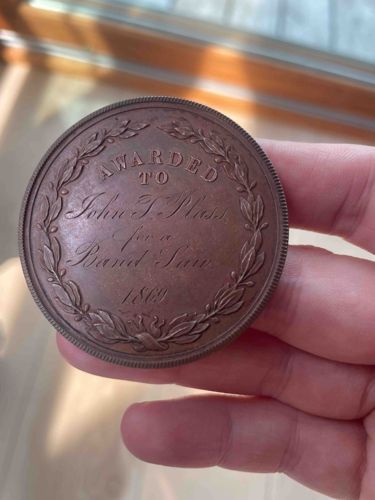
Patent medal round saw 1869

AI analysis below

AI appraisal

AI analysis & estimate

AI-Generated · Verify before acting

Everything below is generated by AI for informational purposes only. AI can make mistakes — the AI may misidentify items or misattribute them (artist, maker, brand, designer, origin, era). This is not an official valuation and should not be used for insurance, sale, tax, estate, legal, or lending purposes — or any decision requiring a certified appraisal. It is not an authoritative claim about any person, brand, or rights holder — do not share or rely on it as a factual statement about a third party. Always consult qualified professionals before making financial decisions.

Note

This analysis also relies on unverified notes provided by the user, which may be incomplete or inaccurate and could affect the result.

Read the full disclaimer

AI Identification

·Not independently authenticated·Verify before acting

John T. Plass Band Saw Patent/Award Medal

Medal/Award

AI Estimated Value

·Not an official valuation·Verify before acting

$750 - $1,200

As of May 27, 2026

AI Item Analysis

·AI can make mistakes·Verify before acting
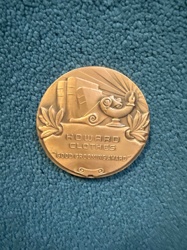
This item is a circular, flat medal, appearing to be crafted from copper or a copper alloy, given its reddish-brown color and visible patina. The medal features a raised rim with a reeded edge, similar to that found on coins, indicating a machine-struck or precisely cast manufacturing process. The obverse side, which is visible, is engraved with an inscription that reads: "AWARDED TO John T. Plass for a Band Saw 1869." The lettering appears to be in a serif font for 'AWARDED TO' and a more flowing, script-like font for 'John T. Plass' and 'for a Band Saw', with '1869' in a simpler serif font. The central inscription is encircled by a finely detailed laurel wreath design, indicating an award for achievement or innovation. The medal shows signs of age consistent with its estimated period, including a visible, somewhat uneven patina that gives it an aged, historic feel. There are minor surface abrasions and marks, which are typical wear for an item of this age that has likely been handled over time, but no significant damage or structural imperfections are apparent. The craftsmanship appears to be of good quality, with clear engraving and well-defined raised elements, suggesting professional production. The specific mention of "Band Saw" and "1869" strongly suggests this was an award related to a patent, invention, or exhibition prize for advancements in industrial or mechanical technology.
AI Appraisal Report

·AI can make mistakes·Verify before acting
Upon examining the provided image and description of the John T. Plass Band Saw Patent/Award Medal, I can offer the following appraisal. The medal appears to be in good condition for its age, exhibiting a consistent, visible patina and minor surface abrasions typical of an item from 1869 that has experienced handling and natural aging. The clear engraving and well-defined elements suggest professional craftsmanship, bolstering its authenticity as a period piece. The reeded edge and laurel wreath design are consistent with award medals of the era. This item's specific connection to John T. Plass and a "Band Saw" in 1869 points to its significance in the history of industrial innovation, likely as a patent award or exhibition prize. In terms of market conditions, medals with specific historical or technological provenance, particularly those tied to known inventors or significant patents, generally command higher interest than generic awards. While direct comparables for a "John T. Plass Band Saw" medal are scarce, similar 19th-century industrial or patent-related awards occasionally appear at auction, fetching values based on their condition, material, and historical context. The rarity of a unique award such as this, combined with its good condition, contributes positively to its demand. Factors significantly impacting its value include its unique inscription, good preservation, and the historical link to industrial machinery. However, limitations arise from examining images alone. I cannot definitively assess its metallic composition without physical examination (e.g., specific gravity testing), nor can I confirm the exact manufacturing process (struck vs. cast) or rule out any hairline cracks/repairs not visible in the image. Full authentication would ideally require in-person examination to verify material composition, a detailed microscopic inspection for authenticity markers, and provenancial documentation linking the medal directly to Plass or the awarding body. Without these, the assessment of authenticity is based solely on visual consistency with period characteristics.

Get your items appraised

Instant estimates of your treasures with AI-powered appraisals

Browse More Appraisals