AI estimate as of November 19, 2025 · verify with a professional before acting
AI-Generated · Verify before acting
Everything on this page is generated by AI for informational purposes only. AI can make mistakes — the AI may misidentify items or misattribute them (artist, maker, brand, designer, origin, era). This is not an official valuation and should not be used for insurance, sale, tax, estate, legal, or lending purposes — or any decision requiring a certified appraisal. It is not an authoritative claim about any person, brand, or rights holder — do not share or rely on it as a factual statement about a third party. Always consult qualified professionals before making financial decisions.
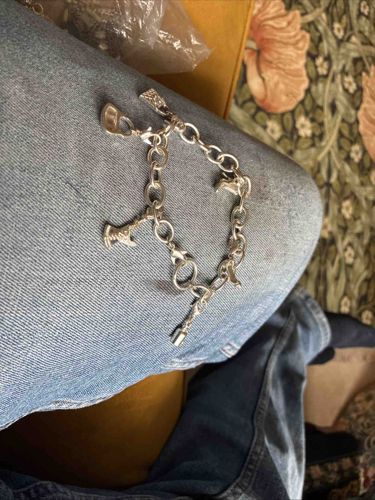
This item is a silver-tone charm bracelet, likely crafted from a base metal with a silver-colored plating, rather than sterling silver, due to the visible gleam and lack of specific hallmarks in the provided image. The bracelet features a sturdy chain link construction, primarily composed of oval-shaped links that are uniform in size and neatly interlocked. The overall length appears suitable for an adult wrist, though exact dimensions are not ascertainable from the image. It is adorned with multiple novelty charms, spaced somewhat irregularly along the chain. Visible charms include a small boot, an axe, and another elongated, somewhat cylindrical charm resembling a key or perhaps a tool. The charms exhibit a three-dimensional, sculptural quality, adding textural interest to the piece. The clasp mechanism appears to be a toggle clasp, characterized by a bar that passes through a ring, providing a secure closure. One end of the bracelet features a decorative, possibly patterned or textured, rectangular component connecting to the clasp. The bracelet presents with a clean, polished appearance, suggesting minimal wear or recent cleaning. There are no obvious signs of significant damage, heavy scratching, or tarnishing. The craftsmanship appears to be of a reasonable quality for costume jewelry, with well-formed links and attached charms. The style suggests a contemporary or modern casual aesthetic, popular for personal accessorizing. The detailed embellishments on the charms indicate a focus on playful or thematic elements. Without maker's marks or stamps, the exact manufacturer and age are difficult to pinpoint, but its style suggests it could be from the latter half of the 20th century or early 21st century.
AI Appraisal Report
I have examined the provided image of this silver-tone charm bracelet with novelty charms. Based on its appearance, I assess its authenticity as a piece of costume jewelry. The visible gleam and lack of apparent hallmarks suggest a base metal construction with silver-colored plating, rather than sterling silver. The condition appears to be very good, showing minimal wear, no significant tarnishing, or damage, suggesting either careful use or recent cleaning. The craftsmanship, while appropriate for costume jewelry, does not indicate high-end manufacturing.
Market conditions for non-precious metal charm bracelets, even those with novelty charms, are generally modest. Comparable items, often found in retail stores or online marketplaces, typically fall within the $20-$50 range, depending on the number and intricacy of charms, and brand if discernible. Demand for such pieces is steady but not high, primarily appealing to individuals seeking a casual, personalized accessory rather than an investment. Rarity is not a factor here; similar styles are mass-produced. Factors significantly impacting value include its material (non-precious), lack of specific maker's marks or provenance, and its general accessibility.
It is crucial to note that this assessment is based solely on visual examination of the image. For full authentication of material composition (e.g., sterling silver vs. plated base metal) and to ascertain potential maker's marks that might be obscured or too small to see, an in-person physical inspection, including magnification and potentially scratch testing or XRF analysis, would be necessary. Without such examination, specific material composition and definitive age cannot be fully determined, limiting a higher valuation.