AI estimate as of October 18, 2025 · verify with a professional before acting
AI-Generated · Verify before acting
Everything on this page is generated by AI for informational purposes only. AI can make mistakes — the AI may misidentify items or misattribute them (artist, maker, brand, designer, origin, era). This is not an official valuation and should not be used for insurance, sale, tax, estate, legal, or lending purposes — or any decision requiring a certified appraisal. It is not an authoritative claim about any person, brand, or rights holder — do not share or rely on it as a factual statement about a third party. Always consult qualified professionals before making financial decisions.
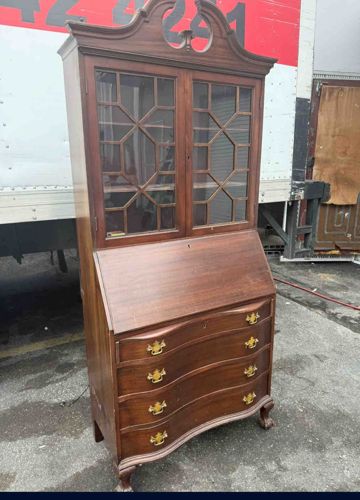
This is a Chippendale style secretary desk, constructed from what appears to be a rich, reddish-brown mahogany wood, showcasing a finely aged patina. The piece is composed of two primary sections: a glazed bookcase top and a slant-front writing desk base with drawers. The upper section features a broken arch pediment with scrolled and pierced fretwork at its center, adding an elegant, decorative flourishcharacteristic of the Chippendale period. Below the pediment, two glazed doors enclose the bookcase, each fitted with intricate geometric muntins that divide the glass panes into a diamond and rectilinear pattern, providing visual interest and protection for items displayed within. The internal shelving is visible through the glass. The lower section of the secretary desk presents a slant-front fall board, which, when opened, would reveal a fitted interior for writing. Below the fall board are four graduated drawers with serpentine or bombe fronts, creating a graceful convex-concave curve. Each drawer is adorned with ornate brass bail pulls and backplates, likely reproductions or original period hardware. The desk is supported by ogee bracket feet, a common feature in 18th-century furniture. While the overall condition appears good given its age, some minor surface wear, scratches, or small chips consistent with antique furniture use might be present, contributing to its authentic character. The construction and style point towards a piece likely manufactured in the mid-to-late 20th century as a reproduction of an 18th-century Chippendale design, or potentially an earlier American Colonial Revival piece from the late 19th or early 20th century. The craftsmanship, particularly the detailed fretwork and serpentine drawer fronts, indicates a higher quality piece of furniture.
AI Appraisal Report
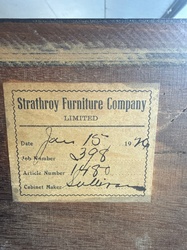
Upon visual examination of this Chippendale Style Secretary Desk with Glazed Bookcase Top, I assess it to be a high-quality reproduction, likely dating from the mid-20th century to possibly early 21st century, rather than an original 18th-century piece. The overall condition appears very good, with what seems to be a well-maintained reddish-brown mahogany finish and an appealing patina. I observe no overtly significant damage from the image, though minor surface wear, scratches, or small chips consistent with age and use would be expected and, in fact, contribute to its character. The finely executed broken arch pediment with scrolled fretwork and the intricate geometric muntins on the glazed doors indicate careful craftsmanship. The serpentine (bombe) front on the four graduated drawers, adorned with brass bail pulls and backplates, further points to a piece made with an appreciation for detailed historical replication. While these hardware elements are well-executed, without physical inspection, it is difficult to determine if they are original to the reproduction or later replacements. Market conditions for quality Chippendale reproductions remain steady. This piece's intricate details, such as the fretwork and bombe drawers, elevate its desirability compared to plainer examples. Comparables for well-crafted Chippendale-style secretary desks in good condition typically fall within the '$1,800 - $2,800' range, with prices varying based on specific maker, exact age of the reproduction, and regional demand. Rarity is moderate for good reproductions, but the quality of this example makes it more desirable. Factors impacting value positively include its excellent stylistic fidelity, detailed craftsmanship, and apparent good condition. The main limitation is confirming authenticity and exact age as a reproduction; an in-person examination would allow for inspection of joinery, wood species, and hardware attachment to verify construction methods and age more precisely. Examining the interior of drawers and the back panel could also provide clues. Furthermore, provenance documentation, if available, would offer valuable context.