AI estimate as of August 8, 2025 · verify with a professional before acting
AI-Generated · Verify before acting
Everything on this page is generated by AI for informational purposes only. AI can make mistakes — the AI may misidentify items or misattribute them (artist, maker, brand, designer, origin, era). This is not an official valuation and should not be used for insurance, sale, tax, estate, legal, or lending purposes — or any decision requiring a certified appraisal. It is not an authoritative claim about any person, brand, or rights holder — do not share or rely on it as a factual statement about a third party. Always consult qualified professionals before making financial decisions.
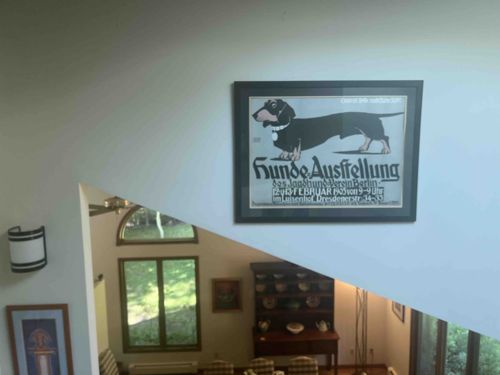
The item is a framed art print or poster, prominently featuring a stylized depiction of a black dachshund on a light background. The overall color palette is largely monochromatic with black, white, and various shades of grey, though there might be subtle hints of blue or green in the background, possibly from discoloration or the original print's muted tones. The dachshund is rendered with thick, bold outlines, showcasing its characteristic long body and short legs. It appears to be wearing a collar with a tag. Below the dog, the typography includes a large, bold German title, "Hunde Ausstellung" (Dog Exhibition), and smaller text below that appears to provide details about the exhibition, including a date and location, likely in Berlin. The text below the main title reads "Das Jagdhunde-Verein Berlin - 12./13. FEBRUAR von 9-10 Uhr Im Lunenhof, Dresdener Str. 34-35". This detail suggests the item is a vintage exhibit poster, possibly from the early to mid-20th century, given the artistic style and typography which align with early modern graphic design. The print is housed in a simple, dark-colored frame, likely black or a very dark brown, with a narrow profile. The frame appears to be made of wood or a similar composite material, and it has a glass or acrylic glazing protecting the print. No obvious damage or significant wear is visible on the print itself from the image provided, though the dark frame blends somewhat with the print, making it hard to discern precise edges or minor imperfections. The print seems to be in relatively good condition, with no apparent tears, creases, or major fading visible from this distance. The craftsmanship of the poster appears to be that of commercial printing, likely lithography, given the crisp lines and solid color fields. The framing itself is standard, suggesting a utilitarian approach to display rather than elaborate custom work.
AI Appraisal Report
Upon visual examination of this 'Hunde Ausstellung' Dachshund Poster, I assess its condition as very good for a vintage piece. The print exhibits crisp lines and solid color fields, typical of commercial lithography of its era. No apparent tears, creases, or significant fading are visible from the provided image, suggesting careful preservation. The dark, simple frame appears to be in good condition, offering adequate protection to the print. Authenticity, based solely on visual cues, strongly suggests a genuine vintage exhibition poster from the early 20th century (likely 1920s-1930s) given the specific date (Feb 12/13) and detailed Berlin location. The artistic style and typography align with graphic design trends of that period.
Market conditions for vintage European exhibition posters, particularly those featuring animals or specific breeds, remain steady. Comparables include other early 20th-century German exhibition posters, where values can range significantly based on rarity, artist, and subject matter. Dachshund-related art has a consistent demand among breed enthusiasts and collectors of vintage advertising. While not exceedingly rare, this poster's specific details, coupled with its apparent good condition, enhance its desirability.
Factors significantly impacting value include its vintage authenticity, the appealing subject matter, and its preserved condition. The primary limitation in full authenticity verification from images alone is the inability to examine print quality under magnification, assess paper type for age appropriateness, or detect any restoration. Further authentication would benefit from an in-person examination to check for watermarks, printing techniques (e.g., dot patterns), and paper fiber analysis. Provenance documentation, such as prior ownership history or exhibition records, would solidify its authenticity. Without physical inspection, I cannot rule out the possibility of a high-quality contemporary reproduction, although the visual evidence leans towards originality.