AI estimate as of September 12, 2025 · verify with a professional before acting
AI-Generated · Verify before acting
Everything on this page is generated by AI for informational purposes only. AI can make mistakes — the AI may misidentify items or misattribute them (artist, maker, brand, designer, origin, era). This is not an official valuation and should not be used for insurance, sale, tax, estate, legal, or lending purposes — or any decision requiring a certified appraisal. It is not an authoritative claim about any person, brand, or rights holder — do not share or rely on it as a factual statement about a third party. Always consult qualified professionals before making financial decisions.
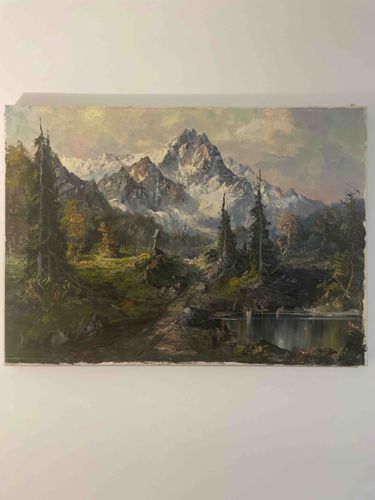
This item is an oil painting depicting a dramatic mountain landscape. The painting is rendered on what appears to be canvas, stretched over a support, though the frame is not visible in the provided image. The color palette is rich, dominated by greens and browns in the foreground and mid-ground foliage, transitioning to cooler blues, grays, and whites for the snow-capped mountain peaks in the background. The sky shows hints of pinks, yellows, and light blues, suggesting either dawn or dusk, or a diffused light. Numerous trees, likely conifers due to their dark, slender forms, are prominent on either side of the composition and along the lower slopes of the mountains, adding depth and scale. A body of water, possibly a lake or river, with reflections of the sky and trees, is visible in the lower right portion of the painting. The artistic style suggests a late 19th or early 20th-century Romantic or Realist approach, with visible brushstrokes indicating a painterly quality and texture. There are no visible signatures or maker's marks from the image provided. The edges of the canvas appear slightly uneven and may show minor wear or tacking marks, typical of an unframed or recently unframed artwork. No significant damage like tears, punctures, or extensive paint loss is evident, though a full assessment would require closer inspection. The overall craftsmanship suggests a skilled hand, with attention to light, shadow, and atmospheric perspective. The painting captures a serene yet majestic natural scene, indicative of landscape art traditions focused on the grandeur of nature.
AI Appraisal Report
Based on my visual examination of the provided image, this Mountain Landscape Oil Painting appears to be a competently executed work on canvas. The condition, from what I can discern, seems good; there are no obvious tears, punctures, or significant paint loss. The slightly uneven edges and tacking marks are typical of an unframed work or one recently removed from a frame, and do not necessarily indicate damage. The artistic style, with its painterly quality and focus on atmospheric perspective, aligns with late 19th or early 20th-century Romantic or Realist landscape traditions, suggesting a period consistent with the visual cues.
Market conditions for unsigned landscape paintings from this era vary widely. While the quality of execution is apparent, the lack of a visible signature significantly impacts its provable authenticity and therefore, its market value. Comparable unsigned works of similar quality by lesser-known artists typically fetch in the range of $800 to $1,500 in today's market, especially if they are aesthetically pleasing and in good condition. The demand for well-executed traditional landscapes remains stable, but without an identified artist, rarity is difficult to ascertain beyond its individual uniqueness.
The primary factor significantly impacting value here is the absence of an artist's signature or provenance. While the work is skilled, I cannot definitively attribute it to a specific artist from the image alone. For full authentication and to potentially increase its value, an in-person examination would be crucial to inspect brushwork details, canvas weave, and potential hidden signatures. Further research into provenance, perhaps through art historical records or by identifying the specific location depicted, would also be invaluable. Scientific testing, such as pigment analysis, could confirm its period authenticity.