AI estimate as of September 28, 2025 · verify with a professional before acting
AI-Generated · Verify before acting
Everything on this page is generated by AI for informational purposes only. AI can make mistakes — the AI may misidentify items or misattribute them (artist, maker, brand, designer, origin, era). This is not an official valuation and should not be used for insurance, sale, tax, estate, legal, or lending purposes — or any decision requiring a certified appraisal. It is not an authoritative claim about any person, brand, or rights holder — do not share or rely on it as a factual statement about a third party. Always consult qualified professionals before making financial decisions.
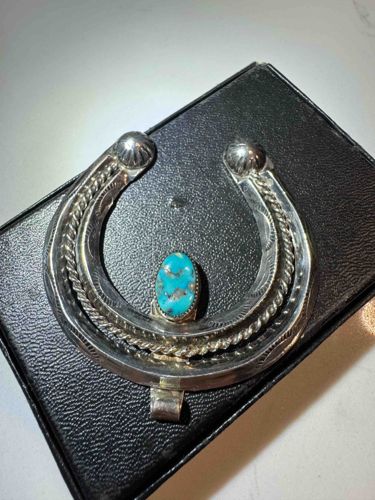
This is a distinctive Native American style Naja pendant crafted from sterling silver and featuring a prominent turquoise cabochon. The pendant takes on the classic horseshoe or crescent shape, characteristic of Naja designs often seen in Navajo and Zuni jewelry. It is composed of multiple layers: an outer, wider band of sterling silver that is decorated with a series of parallel lines, possibly hand-stamped or chased, giving it a textural quality. Inside this outer band, there are two narrower, rope-twist sterling silver wires that add depth and intricate detail to the design. These elements are soldered together to form the curvilinear shape. At the terminals of the Naja, the silver is capped with fluted dome-shaped accents, adding a finished and decorative touch. Centered at the bottom arch of the Naja is an oval-shaped turquoise stone, bezel-set in sterling silver. The turquoise exhibits a beautiful robin's egg blue color with visible matrix, suggesting a natural origin and likely contributing to its character. The bezel setting around the turquoise is plain. Below the turquoise and at the very center bottom of the Naja, there is a simple sterling silver bail, allowing the piece to be worn as a pendant on a necklace. The silver shows a noticeable patina, indicating age and lack of recent polishing, which is often desirable in vintage Native American jewelry. No obvious maker's marks or signatures are discernible from the provided image. The craftsmanship appears solid with clean soldering and consistent decorative work, suggesting a moderate to high level of quality for its style. The overall design exudes a classic Southwestern aesthetic.
AI Appraisal Report
Based on my visual examination of the provided image, this Native American style Naja pendant exhibits good craftsmanship and a classic Southwestern aesthetic. The sterling silver construction, layered design with parallel lines, rope-twist wires, and fluted dome accents demonstrate thoughtful detail. The bezel-set oval turquoise cabochon, with its robin's egg blue color and visible matrix, appears natural and is a desirable feature. The noticeable patina suggests age and authentic wear, often sought after in vintage pieces.
From a market perspective, comparable Native American style sterling silver Naja pendants with natural turquoise typically range from $200 to $500, depending heavily on the artist, stone quality, and silver weight. This pendant's design is popular, ensuring consistent demand within the Southwestern jewelry market. While not inherently rare, the quality of execution and natural turquoise elevate its appeal.
Factors impacting value positively include the natural turquoise, intricate silver-work, and classic design. The absence of discernible maker's marks or signatures, however, prevents attribution, which would significantly increase its value if identifiable. The pendant's condition appears very good, consistent with age, with no visible damage. For full authentication and to confirm material purity, an in-person examination would be critical to test the silver, verify the turquoise's natural origin definitively, assess total weight, and thoroughly search for any hidden hallmarks. Without provenance documentation or physical inspection, I cannot conclusively verify its precise age or Native American artisan origin, thus affecting the appraisal's upper range.