AI estimate as of November 4, 2025 · verify with a professional before acting
AI-Generated · Verify before acting
Everything on this page is generated by AI for informational purposes only. AI can make mistakes — the AI may misidentify items or misattribute them (artist, maker, brand, designer, origin, era). This is not an official valuation and should not be used for insurance, sale, tax, estate, legal, or lending purposes — or any decision requiring a certified appraisal. It is not an authoritative claim about any person, brand, or rights holder — do not share or rely on it as a factual statement about a third party. Always consult qualified professionals before making financial decisions.
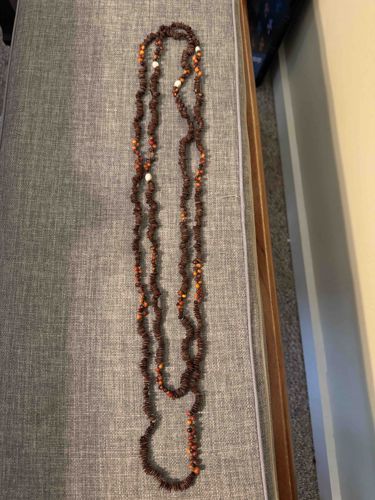
This is a long, multi-strand necklace, likely designed to be worn wrapped multiple times or as a long, dangling piece. It primarily consists of numerous small, disc-shaped, dark brown beads, which appear to be natural seeds or shell fragments. These dark beads form the bulk of the strands and have a textured, somewhat irregular surface. Interspersed throughout these dark beads are round, polished beads of two distinct types: a significant number of smaller, spherical beads in varying shades of orange and light brown, suggesting natural wood or possibly amber, and fewer, larger, off-white, opaque spherical beads, which could be shell, bone, or a ceramic material. The overall construction appears to be strung on a flexible cord, possibly made of natural fiber given the organic nature of the beads. The strands exhibit a somewhat wavy, free-flowing drape, indicating a lack of rigid structure or specific bead-to-bead knotting, allowing for natural movement. There are no visible clasps, suggesting it is an 'endless' necklace or simply very long. The item appears to be in good condition with no obvious breaks or missing beads, though close inspection would be needed to confirm the integrity of the stringing and the condition of individual beads. The style suggests a handcrafted, bohemian, or ethnic origin, possibly from a coastal or tropical region, dating likely from the mid-20th century onwards. The natural materials and handcrafted appearance suggest a focus on natural aesthetics and traditional craftsmanship, rather than high-value precious materials. The varying sizes and colors of the spacer beads add visual interest and a subtle warmth to the earthy tones.
AI Appraisal Report
Upon examining the image of this multi-strand seed and bead necklace, my initial assessment suggests it is in good condition, with no visible breaks or missing beads, and the stringing appears intact from what can be observed. The authenticity, based purely on visual cues, points to a handcrafted piece utilizing natural materials. The dark disc-shaped beads appear to be natural seeds or shell fragments, while the orange/light brown spherical beads resemble wood or amber, and the larger off-white beads could be shell, bone, or ceramic. The overall aesthetic leans towards a bohemian, ethnic, or artisanal style. This piece likely dates from the mid-20th century onwards.
Market conditions for such items typically fall into the costume jewelry or artisanal crafts segment. Comparables include handcrafted necklaces found in specialty boutiques, artisan markets, or online platforms focusing on natural and bohemian jewelry. Demand for these types of pieces is generally steady among collectors and individuals appreciating unique, natural, and handcrafted aesthetics, but it is not considered rare in a high-value sense.
The primary factors impacting value are the natural (non-precious) materials and the handcrafted nature. The materials themselves are common and not intrinsically valuable. The craftsmanship appears competent but not exceptionally refined. Without precious metals or gemstones, the value is primarily driven by design appeal and the 'story' if any provenance were attached.
Limitations to authenticity verification from images alone are significant. I cannot definitively confirm the material composition of the beads (e.g., if the 'amber' is true amber or resin, if 'shell' is indeed shell), the type of stringing material, or the exact age. In-person examination would be crucial to assess the integrity of the stringing, potential wear or damage to individual beads not visible in the image, and to perform specific gravity tests or other analyses if material identification (e.g., amber vs. resin) were critical. Provenance documentation would be invaluable for establishing origin and dating, and scientific testing could confirm bead materials definitively.