AI estimate as of October 26, 2025 · verify with a professional before acting
AI-Generated · Verify before acting
Everything on this page is generated by AI for informational purposes only. AI can make mistakes — the AI may misidentify items or misattribute them (artist, maker, brand, designer, origin, era). This is not an official valuation and should not be used for insurance, sale, tax, estate, legal, or lending purposes — or any decision requiring a certified appraisal. It is not an authoritative claim about any person, brand, or rights holder — do not share or rely on it as a factual statement about a third party. Always consult qualified professionals before making financial decisions.
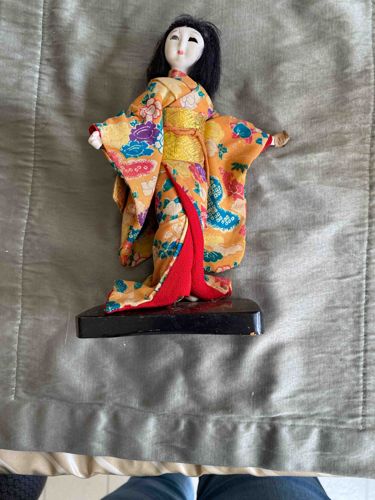
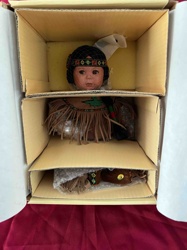
This item is a traditional Japanese Geisha doll, approximately 10-12 inches in height, posed in a standing position on a rectangular black lacquered wooden base. The doll's face is light-skinned with delicately painted features, including almond-shaped eyes, dark eyebrows, and a small red mouth. Its hair appears to be black, possibly synthetic or real human hair, styled simply. The doll is dressed in a vibrant, patterned kimono, primarily in shades of orange with intricate floral and geometric designs in purple, blue, green, and red. The kimono features wide sleeves and a red lining visible at the cuffs and along the bottom edge, indicating an inner garment or lining. A golden obi (sash) is tied around the waist, adding a touch of elegance. The hands of the doll are visible, appearing to be made of a cream-colored material, possibly bisque, porcelain, or plastic. The black base shows some minor scuffs or wear marks, consistent with age and handling. The overall condition appears good, with no obvious major damage like cracks or tears in the fabric, although closer inspection would be needed to assess the exact material condition and any subtle fading. Given its traditional attire and style, the doll likely dates from the mid-to-late 20th century, probably intended for decorative display. The craftsmanship, particularly in the detailed kimono fabric and painted facial features, suggests a mass-produced souvenir or decorative item rather than a high-end artisan creation, but it still represents a classic example of Japanese doll artistry.
AI Appraisal Report
Based on my visual examination of the provided image, this Japanese Geisha doll appears to be in good overall condition. The vibrant kimono, featuring intricate patterns in shades of orange, purple, blue, green, and red, shows no obvious tears or significant fading, though a closer, in-person inspection would be needed to confirm fabric integrity and subtle discoloration. The delicately painted facial features and simple black hairstyle are consistent with traditional Japanese doll artistry. The black lacquered wooden base exhibits minor scuffs, which is expected with age and handling. Authenticity, in terms of it being a genuine Japanese-made doll, is highly probable given the traditional styling and materials. However, without physical examination, I cannot definitively confirm the material of the hair (synthetic vs. human) or the doll's hands (bisque, porcelain, or plastic). I also cannot assess the internal construction or any hidden damages.
Market conditions for such decorative Japanese Geisha dolls, particularly mass-produced souvenir types from the mid-to-late 20th century, generally reflect a moderate demand. They are not considered rare; many similar examples are available from various online retailers and antique markets. Comparables typically range from $20 to $75, depending on size, condition, and perceived craftsmanship. Factors impacting value include the doll’s condition, the perceived artistry of the painting and kimono, and its age. This particular doll, while charming and well-preserved, does not exhibit the characteristics of a high-end artisan creation that would command a premium. Therefore, its primary value is as a decorative collectible. A full authentication would require in-person inspection to evaluate materials, assess construction methods, and identify any maker's marks or signatures. Provenance documentation, such as original receipts or family history, would also be beneficial for establishing origin and specific age.