AI estimate as of August 27, 2025 · verify with a professional before acting
AI-Generated · Verify before acting
Everything on this page is generated by AI for informational purposes only. AI can make mistakes — the AI may misidentify items or misattribute them (artist, maker, brand, designer, origin, era). This is not an official valuation and should not be used for insurance, sale, tax, estate, legal, or lending purposes — or any decision requiring a certified appraisal. It is not an authoritative claim about any person, brand, or rights holder — do not share or rely on it as a factual statement about a third party. Always consult qualified professionals before making financial decisions.
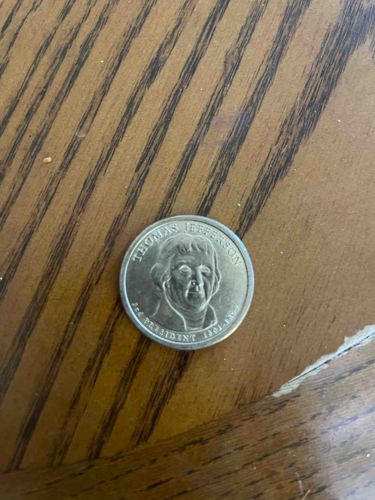
The item is a United States Presidential Dollar coin, specifically featuring Thomas Jefferson. It appears to be made of a golden-colored metallic alloy, characteristic of these dollar coins, which are composed of manganese brass clad with a pure copper core. The coin has a circular shape with a reeded edge (though the edge is not visible in the provided image). The obverse side, which is visible, prominently displays a portrait of Thomas Jefferson. Above his likeness, the name "THOMAS JEFFERSON" is inscribed along the top curve of the coin. Below the portrait, the text "3rd PRESIDENT" is visible, followed by what appears to be the years of his presidency, "1801-1809". The relief of the portrait and lettering is clear and well-defined, indicating good strike quality. The coin exhibits some signs of circulation, primarily a slight decrease in luster across the field, but no significant scratches, dents, or wear to the high points of the design are readily apparent. The color is consistent with circulated manganese brass, showing a warm, somewhat muted golden tone. This coin is part of the Presidential $1 Coin Program, which began in 2007. Given its design, it likely dates from this modern era of U.S. coinage. The craftsmanship appears to be standard for U.S. Mint production.
AI Appraisal Report
Based on my visual examination of the provided image of the Thomas Jefferson Presidential Dollar Coin, I can offer the following professional appraisal. The coin appears to be an authentic U.S. Mint issue from the Presidential $1 Coin Program, launched in 2007. The visible obverse design, including the portrait, inscriptions ("THOMAS JEFFERSON," "3rd PRESIDENT," "1801-1809"), and metallic color, is consistent with known examples of this series. The coin exhibits signs of light circulation, indicated by a slight loss of original luster, but no significant abrasions, dents, or wear to the high points of the design are apparent. I would assess its condition as somewhere in the About Uncirculated (AU) to Brilliant Uncirculated (BU) range, though a definitive grade requires in-person inspection.
Market conditions for Presidential dollar coins, generally, are quite stable. These coins were produced in very high mintages and were widely used, so they are not considered rare. Demand for circulated examples is typically low among collectors, as most seek out uncirculated or proof versions. Comparables would be other circulated Presidential dollar coins, which commonly trade for face value or a small premium. Factors significantly impacting value for this series are typically limited to key errors (e.g., missing edge lettering), which cannot be determined from this single image, or pristine, high-grade examples (MS-68 or higher), which this coin does not appear to be.
Limitations in authenticity verification from an image alone are significant. While the visible elements align with known genuine coins, a definitive authentication would require physical inspection to verify the reeded edge for mint marks and mottoes, assess weight and dimensions, and perform a full surface examination under magnification for any anomalies or signs of alteration. Provenance documentation (e.g., original mint packaging, purchase receipts) could also aid in verification. No scientific testing is typically needed for a standard issue coin like this unless specific counterfeit concerns arise during physical inspection.