AI estimate as of October 23, 2025 · verify with a professional before acting
AI-Generated · Verify before acting
Everything on this page is generated by AI for informational purposes only. AI can make mistakes — the AI may misidentify items or misattribute them (artist, maker, brand, designer, origin, era). This is not an official valuation and should not be used for insurance, sale, tax, estate, legal, or lending purposes — or any decision requiring a certified appraisal. It is not an authoritative claim about any person, brand, or rights holder — do not share or rely on it as a factual statement about a third party. Always consult qualified professionals before making financial decisions.
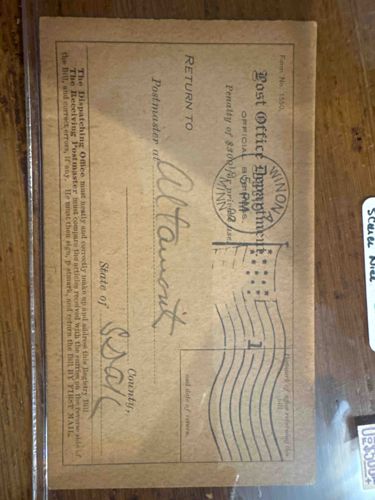
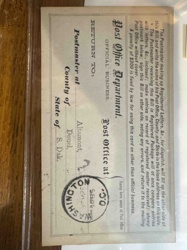
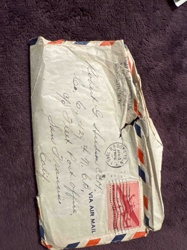
This item is an antique or vintage U.S. Post Office Department Registry Bill, specifically Form No. 1550. It is a light brown or tan piece of paper, appearing to be made of a sturdy cardstock or heavy paper, and is presented in a vertical orientation, likely preserved within a plastic sleeve or protector. The form is printed with official U.S. Post Office Department details, including 'Form No. 1550' at the top left and 'Post Office Department' prominently displayed. A circular handstamp or cancelation mark with 'WINONA MINN' and a date/time (partially obscured, but appears to be 'OFFICIAL 6 PM') is visible on the upper right side. Below this, there's a printed penalty notice: 'Penalty of $300'. The form also features a stylized postal cancellation mark with wavy lines and the number '1' within a rectangular box, designed to be placed over a stamp or indicia. Handwritten entries are visible on the form, indicating 'RETURN TO Postmaster at Altamont' and 'State of S.DAk', likely referring to Altamont, South Dakota. Beneath these handwritten entries, there are printed instructions for 'The Dispatching Office' and 'The Receiving Postmaster' outlining procedures for handling registered mail, emphasizing the need to compare articles with the registry bill and to sign, postmark, and return the bill by first mail. The paper shows slight discoloration consistent with age, and a faint vertical crease or fold is discernible near the center. The edges appear relatively clean, suggesting it has been well-preserved. The overall condition suggests that while it is an aged document, it has avoided significant damage like tears or major stains.
AI Appraisal Report
I have examined the provided image of this U.S. Post Office Department Registry Bill, Form No. 1550. My assessment is that this is an authentic vintage postal form. The 'WINONA MINN' circular handstamp, the 'Penalty of $300' text, and the stylized wavy line cancellation mark are consistent with postal ephemera from the early to mid-20th century. The handwritten entries indicating 'RETURN TO Postmaster at Altamont' and 'State of S.DAk' add a layer of historical context, connecting it to a specific transaction.
Condition-wise, the item appears very good for its age, preserved likely in a protector. Slight discoloration and a faint vertical crease are noted, which is typical for paper items of this vintage. Minor wear does not significantly detract from its appeal. This type of form, while official, was a functional document, and many were discarded after use, making those that survived collectible.
In terms of market conditions, similar U.S. Post Office Department forms, particularly those with clear cancels or interesting handwritten addresses, typically fall into the $25-$50 range. While not exceedingly rare, their historical significance for postal historians and collectors of philatelic ephemera creates a steady demand. Factors impacting value positively include the clear Winona, MN cancel and the Altamont, SD association. The 'OFFICIAL 6 PM' time stamp is a nice detail.
Limitations exist in full authentication from images alone. I cannot definitively verify the paper stock, ink types, or exact age without physical inspection. For complete assurance, an in-person examination would allow for tactile assessment, examination under magnification to verify print methods, and potentially chemical analysis of the paper and ink if warranted. Provenance documentation, though unlikely for such an item, could also solidify its history, but is not typically expected for this type of postal artifact.