AI estimate as of September 7, 2025 · verify with a professional before acting
AI-Generated · Verify before acting
Everything on this page is generated by AI for informational purposes only. AI can make mistakes — the AI may misidentify items or misattribute them (artist, maker, brand, designer, origin, era). This is not an official valuation and should not be used for insurance, sale, tax, estate, legal, or lending purposes — or any decision requiring a certified appraisal. It is not an authoritative claim about any person, brand, or rights holder — do not share or rely on it as a factual statement about a third party. Always consult qualified professionals before making financial decisions.
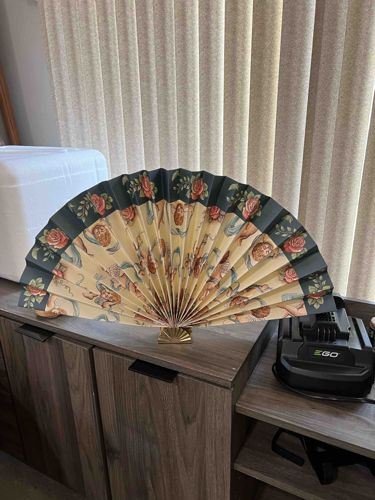
This item is a decorative, pleated fabric hand fan, displayed open on a metallic stand. The fan itself appears to be constructed from a paper or light fabric sheet, meticulously folded into a fan shape, and then affixed to a series of radiating sticks that terminate at a pivot point, though these sticks are not clearly visible here. The primary color of the fan's body is a subdued cream or light yellow, adorned with intricate, multi-colored illustrations. These illustrations feature what appear to be classical figures or cherubs in various poses, suggesting a Rococo or Neoclassical artistic influence. The upper and lower edges of the fan's main body are bordered with a darker, possibly dark green or blue-gray band, upon which vibrant rose motifs with green foliage are painted. The overall condition appears good, with no obvious tears, significant discoloration, or major damage visible from the angle provided. The pleats are well-defined, indicating good structural integrity. The stand holding the fan is small, made of a metallic material, likely brass or a brass-toned alloy, and has a flared, fan-like base that echoes the shape of the item it supports. Its surface shows a slight sheen, suggesting polished metal. This type of fan is commonly used for display rather than function, given its open, permanent presentation.
AI Appraisal Report
Based on my visual examination of the provided image, this decorative pleated fabric hand fan on a metallic stand appears to be in good overall condition. The pleats are well-defined, and I observe no obvious tears, significant discoloration, or major damage, suggesting careful handling and storage. The intricate, multi-colored illustrations of classical figures or cherubs, bordered by rose motifs, point to a Rococo or Neoclassical aesthetic, likely placing its creation in the late 19th to early 20th century. The metallic stand, probably brass, complements the fan well.
However, it's crucial to note the limitations of appraising from images alone. I cannot definitively assess the material quality, the true age, or the craftsmanship of the unseen fan sticks. Furthermore, without physical inspection, I cannot determine if the 'fabric' is actually paper, silk, or another material, which significantly impacts value. Authenticity, especially regarding period and origin, cannot be fully verified without examining construction techniques, material composition, and any maker's marks.
In terms of market conditions, decorative fans of this type, especially those intended for display rather than functional use, generally appeal to collectors of decorative arts or Victoriana/Edwardiana. While the aesthetic is charming, its decorative nature and the likely absence of a prominent maker limit its rarity and broad market demand compared to functional, historically significant, or artist-signed fans. Comparables tend to fall in the lower hundreds for good quality, mass-produced decorative items.
A definitive appraisal would require in-person examination to verify material integrity, construction details, and identify any hidden damage or repairs. Provenance documentation, such as receipts or family histories, would also be invaluable for authentication and establishing a more precise age. Scientific testing, like fiber analysis or pigment analysis, could confirm materials and age if a higher value justified such an expense. Given these limitations, and assuming it is a decorative piece from the late 19th/early 20th century without significant historical provenance, I estimate its appraisal value to be in the range of $100-$200.