AI estimate as of September 19, 2025 · verify with a professional before acting
AI-Generated · Verify before acting
Everything on this page is generated by AI for informational purposes only. AI can make mistakes — the AI may misidentify items or misattribute them (artist, maker, brand, designer, origin, era). This is not an official valuation and should not be used for insurance, sale, tax, estate, legal, or lending purposes — or any decision requiring a certified appraisal. It is not an authoritative claim about any person, brand, or rights holder — do not share or rely on it as a factual statement about a third party. Always consult qualified professionals before making financial decisions.
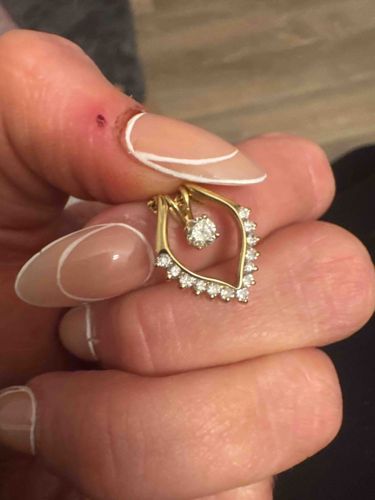
This item is a gold and diamond heart-shaped pendant, designed to be worn on a necklace. The pendant features a prominent, brilliant-cut diamond suspended at its center, creating a focal point. This central diamond appears to be prong-set, allowing maximal light entry for sparkle. Surrounding the lower curve of the heart shape is a graduated cluster of smaller, brilliant-cut diamonds, collectively forming a dazzling border. These smaller diamonds are also prong-set, meticulously arranged to enhance the overall brilliance of the piece. The metal appears to be yellow gold, possibly 10k or 14k based on its color, and exhibits a polished finish. The design of the heart is asymmetric, with one side forming a graceful curve that swoops inwards, creating a dynamic and modern interpretation of the classic heart motif. A prominent bail, also crafted from yellow gold, is integrated at the top of the pendant, allowing it to be strung on a chain. The craftsmanship suggests a commercially produced piece, likely from the late 20th to early 21st century. No manufacturing marks or signatures are visible in the provided image. The diamonds appear clean and well-maintained, showing good clarity and fire. The overall condition appears excellent, with no noticeable wear, chips, or damage to the diamonds or the gold setting, indicating it has been well-cared for or is relatively new. The design offers both elegance and sparkle, appealing to a classic yet contemporary aesthetic.
AI Appraisal Report
Based on my visual examination of the provided image, this gold and diamond heart-shaped pendant appears to be in excellent condition, with no visible wear, chips, or damage to the diamonds or the gold setting. The clarity and fire of the brilliant-cut diamonds, both the central stone and the surrounding graduated cluster, appear good. The yellow gold setting, likely 10k or 14k, exhibits a polished finish. The design suggests a commercially produced piece from the late 20th to early 21st century, with its asymmetric heart motif offering a modern touch to a classic design.
Market conditions for commercially produced diamond pendants are generally stable. This piece, with its combination of a central diamond and a diamond-studded frame, represents a popular and desirable style. While not rare, the aesthetic appeal and quality of the diamonds contribute to its marketability. The primary factors impacting value are the carat weight, clarity, and color of the diamonds, and the karat of the gold. Without knowing the precise carat weight of the central diamond and the total carat weight of the smaller diamonds, or their specific color and clarity grades, a more definitive valuation is challenging. The craftsmanship, while good, suggests mass production rather than bespoke artistry, which limits its rarity value.
It is crucial to note the limitations of an appraisal based solely on images. While the visual indicators are positive, I cannot definitively verify the authenticity of the diamonds as natural, nor confirm their exact quality (carat, color, clarity) or the gold's karatge. An in-person examination would allow for precise measurements of the diamonds, assessment of their quality using a jeweler's loupe, and verification of the gold's purity through testing. Furthermore, a physical inspection could reveal any hidden manufacturing marks or internal inclusions not visible in the image. Provenance documentation, if available, would also aid in confirming its history and authenticity. Without these, the appraisal remains an informed estimate.