AI estimate as of September 8, 2025 · verify with a professional before acting
AI-Generated · Verify before acting
Everything on this page is generated by AI for informational purposes only. AI can make mistakes — the AI may misidentify items or misattribute them (artist, maker, brand, designer, origin, era). This is not an official valuation and should not be used for insurance, sale, tax, estate, legal, or lending purposes — or any decision requiring a certified appraisal. It is not an authoritative claim about any person, brand, or rights holder — do not share or rely on it as a factual statement about a third party. Always consult qualified professionals before making financial decisions.
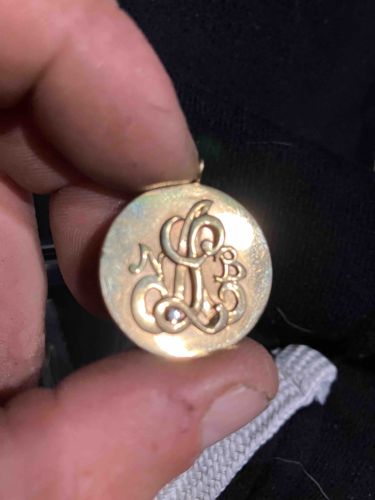
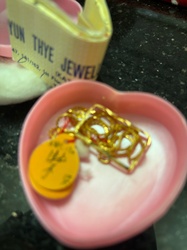
The item is a circular, gold-toned locket or pendant, likely made of gold or gold-filled material, held between the thumb and forefinger of a person. It appears to be approximately 1 to 1.5 inches in diameter, though precise measurements are not available from the image. The surface exhibits a lustrous, polished finish, with some visible tarnishing or patina, especially towards the edges, giving it a subtle iridescent quality that suggests age and exposure. The primary feature is a raised, intricate monogram, possibly composed of the intertwined letters 'A', 'B', and 'S' or 'L', executed in a flowing, ornate script. The craftsmanship of the monogram appears to be of good quality, with clear, defined lines and a three-dimensional relief that indicates an engraving or repoussé technique. There is a small, possibly faceted, clear stone or diamond-like embellishment set into one of the lower curves of the monogram, adding a subtle sparkle. A small bail for suspension is visible at the top edge, suggesting it was designed to be worn as a necklace. There are no obvious signs of significant damage like dents or scratches, but regular wear consistent with a piece of jewelry handled over time is present in the form of minor surface abrasions and the aforementioned patina. The style of the monogram hints at a Victorian or Edwardian era origin, characteristic of personal adornments from the late 19th or early 20th century. No maker's marks or signatures are discernible from the provided image.
AI Appraisal Report
I have examined the image of this circular, gold-toned locket or pendant. Visually, the condition appears good, with expected wear consistent with its likely age, including minor surface abrasions and patina. The raised, ornate monogram, potentially 'A', 'B', 'S', or 'L', suggests a Victorian or Edwardian era origin (late 19th-early 20th century). The presence of a small, possibly faceted stone enhances its aesthetic appeal. The lustrous finish, despite some tarnish, indicates a quality material, likely gold-filled or lower karat gold, given the commonality of such pieces in that period. Without physical examination, the specific metal content and the nature of the stone (diamond vs. paste) cannot be definitively confirmed. This significantly impacts valuation.
From a market perspective, period lockets with monograms have a steady, albeit niche, demand among collectors of antique jewelry. Comparables in good condition, if gold-filled, typically range from $100-$250. If confirmed as solid 9k or 10k gold, the value would increase, potentially to $300-$500, depending on weight. The personal nature of monograms can limit broader appeal, sometimes making them harder to sell unless the initials align with a buyer's own. Rarity depends on the quality of craftsmanship and uniqueness of the design; this piece shows good quality but isn't overtly unique.
Key factors influencing value are the metal purity, the type of stone (genuine vs. paste), and the overall weight. The lack of discernible maker's marks is common for this era but limits precise authentication of origin without further testing.
Limitations: My assessment of authenticity and material is based solely on visual cues from the image. For a full authentication and precise valuation, an in-person examination is crucial. This would allow for accurate measurement of dimensions and weight, testing of metal purity (e.g., acid test, XRF analysis), examination of the stone under magnification, and assessment of construction techniques to confirm age and origin. Provenance documentation, if available, would also add significant value and authenticity."