These notes were written by the person who submitted this item. Appraiser.AI has not verified them, and the AI's identification and estimate may rely on them.
AI Estimated Value
Not an official valuation
$600-1,000
AI estimate as of December 14, 2025 · verify with a professional before acting
AI-Generated · Verify before acting
Everything on this page is generated by AI for informational purposes only. AI can make mistakes — the AI may misidentify items or misattribute them (artist, maker, brand, designer, origin, era). This is not an official valuation and should not be used for insurance, sale, tax, estate, legal, or lending purposes — or any decision requiring a certified appraisal. It is not an authoritative claim about any person, brand, or rights holder — do not share or rely on it as a factual statement about a third party. Always consult qualified professionals before making financial decisions.
This analysis also relies on unverified notes provided by the user, which may be incomplete or inaccurate and could affect the result.
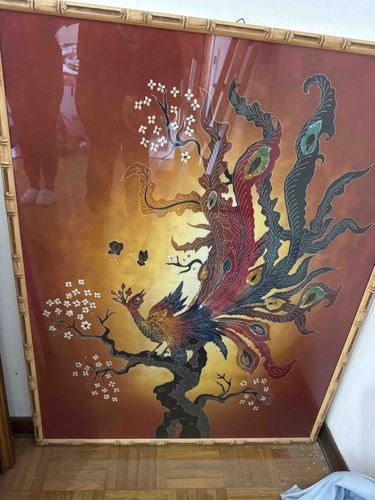
This is a large, framed art panel featuring a vibrant depiction of a phoenix perched on a tree branch with cherry blossoms, rendered in what appears to be a combination of painting and mother-of-pearl inlay. The artwork is enclosed within a distinctive bamboo-style frame, constructed from light-colored wood, possibly stained or lacquered to mimic natural bamboo canes; the individual 'bamboo' sections are clearly visible along the frame's perimeter. The primary artwork presents a majestic phoenix with richly colored plumage in shades of red, blue, green, and gold, showcasing intricate feather patterns, some of which appear to be highlighted with iridescent mother-of-pearl. The phoenix's elaborate tail feathers fan out dramatically into the upper right quadrant of the composition, with several 'eyes' also embellished with mother-of-pearl. The bird is perched on a gnarled, dark-brown tree branch that dominates the lower-center of the panel. Delicate cherry blossoms, depicted in white with small darker centers, are scattered around the branches, especially prominent in the left half and trailing upwards. Small butterflies or moths are also visible in the upper left, adding to the naturalistic scene. The background transitions from a rich, deep reddish-brown at the edges to a lighter, glowing golden-orange towards the center, creating a sunlit or ethereal effect. The artwork is protected by a clear pane of glass or acrylic, which reflects significant glare, indicating a glossy surface underneath or a protective layer. The overall condition appears good with no significant visible damage to the artwork itself, though the protective layer shows some reflections. The frame also appears to be in good condition, consistent with its style. This piece likely represents a traditional East Asian aesthetic, possibly dating from the mid-to-late 20th century, combining painting techniques with the reflective beauty of shell inlay, suggesting a high level of craftsmanship.
AI Appraisal Report
I have carefully examined the provided image of your Framed Mother-of-Pearl Inlay and Paint Art Panel of Phoenix and Cherry Blossoms. Visually, the piece presents beautifully. The condition appears to be very good; I observe no significant damage to the artwork itself, and the bamboo-style frame also looks well-preserved, consistent with its likely mid-to-late 20th-century origin. The combination of painting and mother-of-pearl inlay showcases a high level of craftsmanship, indicative of traditional East Asian artistic techniques.
Market conditions for such decorative wall art, particularly those with intricate mixed media elements, remain steady. Pieces featuring auspicious symbols like the phoenix, especially when rendered with such detail and iridescence from the mother-of-pearl, generally attract collectors interested in East Asian aesthetics. Comparables for pieces of this size and stylistic quality, often found in specialty import stores or estate sales, typically range from $500 to $1,200. Demand is moderate, driven by interior decorators and individuals seeking unique, culturally significant decorative items.
Factors impacting value include the intricate inlay work, the vibrant color palette, and the apparently good condition. The large size also contributes positively to its decorative impact and value. The primary limitation to a definitive appraisal is that authenticity verification is challenging from an image alone. While the style strongly suggests an East Asian origin, an in-person examination would be required to verify the materials used for the paint and inlay, confirm the age of the piece through closer inspection of the frame's construction and patina, and rule out any unseen damage or repairs under different lighting conditions. Provenance documentation, though not provided, would significantly enhance authenticity and value confidence.