AI estimate as of November 13, 2025 · verify with a professional before acting
AI-Generated · Verify before acting
Everything on this page is generated by AI for informational purposes only. AI can make mistakes — the AI may misidentify items or misattribute them (artist, maker, brand, designer, origin, era). This is not an official valuation and should not be used for insurance, sale, tax, estate, legal, or lending purposes — or any decision requiring a certified appraisal. It is not an authoritative claim about any person, brand, or rights holder — do not share or rely on it as a factual statement about a third party. Always consult qualified professionals before making financial decisions.
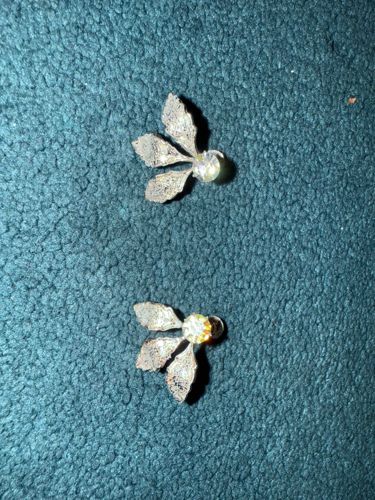
This item consists of a pair of identical stud earrings, each featuring a design reminiscent of a three-leaf clover or a stylized floral element. The primary material appears to be a lightweight, possibly plated, silver-toned metal, crafted with intricate filigree work. Each 'leaf' is delicate and perforated, suggesting a lace-like or openwork construction, which contributes to a translucent effect. The edges of the leaves are slightly irregular, adding to their organic appearance. At the center of each earring, where the three leaf-like structures converge, there is a round, faceted rhinestone. The rhinestones exhibit a multi-faceted sparkle, displaying hues of clear, light yellow, and iridescent orange, suggesting a clear stone with perhaps an aurora borealis or similar coating, or possibly a slight yellowing due to age or original design. The back of the earrings, which would contain the stud post and butterfly clutch (not visible in the image), is designed to hold the rhinestone securely. The overall condition appears good, with no obvious signs of significant damage like bending or missing stones, although some minor discoloration or patina on the metal is possible given its age. The style suggests a mid-20th century to contemporary period, embracing a delicate, nature-inspired, and somewhat romantic aesthetic. The craftsmanship is characterized by its detailed filigree, indicating a level of care in their manufacture, though without maker's marks, it is difficult to ascertain specific origin or higher-end quality.
AI Appraisal Report
I have virtually examined the Filigree Leaf Stud Earrings with Rhinestone Centers. Based on the provided image, the condition appears good, with no obvious signs of significant damage. These earrings feature a delicate, nature-inspired design with intricate filigree work and faceted rhinestones at the center. The metal appears to be a silver-toned, possibly plated base metal, not sterling silver or a precious metal, as indicated by the filigree technique and overall aesthetic which is characteristic of costume jewelry.
Authenticity cannot be fully guaranteed from an image alone. While the design and construction are consistent with mass-produced costume jewelry of the mid-20th century to contemporary periods, without physical inspection, it is impossible to verify the exact metal composition or the quality of the rhinestones. A physical examination would allow me to test the metal for precious content, assess the quality of the rhinestone setting more closely, and identify any maker's marks, which are currently absent.
Currently, the market for vintage costume jewelry such as this is stable. Similar pieces, while charming, are not rare and do not typically command high prices unless they are from a renowned designer or exceptional in their craftsmanship. The demand is niche, appealing to collectors of vintage fashion and costume jewelry rather than high-end jewelry enthusiasts.
Factors impacting value are primarily the material (non-precious metal), the use of rhinestones (not genuine gemstones), and the presumed mass-produced nature. Should the metal unexpectedly be sterling silver or the stones be genuine, the value would increase significantly. However, based on visual evidence, this is unlikely. In-person examination would involve a metal test, a jeweler's loupe inspection of the stones and settings, and a thorough search for any hidden hallmarks. Without physical inspection or provenance documentation, I cannot definitively rule out very subtle flaws or confirm the material composition with 100% certainty, but my assessment is based on the strong visual cues present.