AI estimate as of November 11, 2025 · verify with a professional before acting
AI-Generated · Verify before acting
Everything on this page is generated by AI for informational purposes only. AI can make mistakes — the AI may misidentify items or misattribute them (artist, maker, brand, designer, origin, era). This is not an official valuation and should not be used for insurance, sale, tax, estate, legal, or lending purposes — or any decision requiring a certified appraisal. It is not an authoritative claim about any person, brand, or rights holder — do not share or rely on it as a factual statement about a third party. Always consult qualified professionals before making financial decisions.
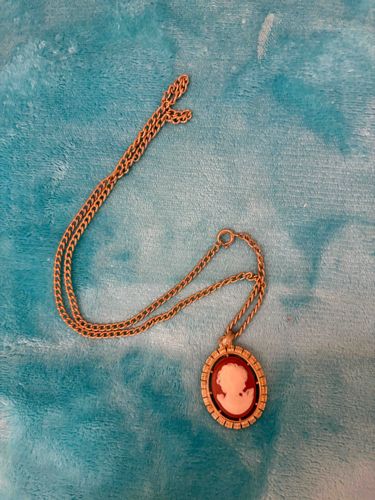
This is a vintage cameo pendant necklace featuring an oval-shaped cameo set in a gold-toned metal frame, attached to a matching gold-toned chain. The cameo itself depicts the profile of a woman, likely carved from a shell or a similar natural material, with a light off-white or cream portrait set against a darker, reddish-brown background. The carving detail appears relatively delicate, showing the outline of the woman's hair, facial features, and neckline. The frame around the cameo has a ribbed or textured edge, adding a subtle decorative element. The chain is a relatively fine, possibly curb or rope chain, with a lobster clasp closure. The overall condition appears to be good for its age, though there might be some minor wear or tarnishing visible on the metal, consistent with vintage jewelry. The piece exudes a classic, romantic aesthetic, characteristic of cameo jewelry that gained popularity from the Victorian era through the mid-20th century. The quality of the carving and the material of the cameo itself would be crucial for a more precise appraisal, but based on visual inspection, it appears to be a commercially produced piece, possibly from the mid-20th century. The craftsmanship seems standard for costume or semi-fine jewelry of that period.
AI Appraisal Report
Based on my visual examination of the provided image, this vintage cameo pendant necklace presents as a commercially produced piece, likely dating from the mid-20th century. The cameo features a finely detailed profile of a woman, carved from what appears to be shell, set against a reddish-brown background. The gold-toned metal frame exhibits a subtle ribbed edge, and the necklace is completed with a matching fine chain and lobster clasp.
The condition appears to be good for its age, consistent with vintage costume or semi-fine jewelry. I note the possibility of minor wear or tarnishing on the metal, which is common for pieces of this era and material. The carving detail of the cameo is delicate, indicating decent craftsmanship for mass-produced items.
In terms of market conditions, vintage cameo jewelry remains popular for its classic aesthetic. However, the value is highly dependent on the material, age, craftsmanship, and artist if known. This particular piece, appearing to be a shell cameo within a gold-toned (rather than solid gold) setting, places it within the realm of accessible vintage jewelry. Demand for such pieces is steady but not exceptionally high for unauthenticated or unsigned examples. Given the likely semi-fine or costume nature of the materials, rarity is not a significant driving factor.
Key factors impacting value here are the quality of the cameo carving itself and the authenticity/material purity of the metal. Without an in-person examination, I cannot definitively confirm the material of the cameo (e.g., shell, glass, or resin) or the exact composition of the gold-toned metal (e.g., gold-filled, plated, or base metal). Provenance documentation would also assist in authenticating its age and origin. A full appraisal would require physical inspection to assess material composition, precise carving quality under magnification, and any maker's marks, which are not discernible from the image alone. These limitations mean the provided value is an estimate based on visual characteristics consistent with similar vintage pieces observed in the market.