AI estimate as of September 11, 2025 · verify with a professional before acting
AI-Generated · Verify before acting
Everything on this page is generated by AI for informational purposes only. AI can make mistakes — the AI may misidentify items or misattribute them (artist, maker, brand, designer, origin, era). This is not an official valuation and should not be used for insurance, sale, tax, estate, legal, or lending purposes — or any decision requiring a certified appraisal. It is not an authoritative claim about any person, brand, or rights holder — do not share or rely on it as a factual statement about a third party. Always consult qualified professionals before making financial decisions.
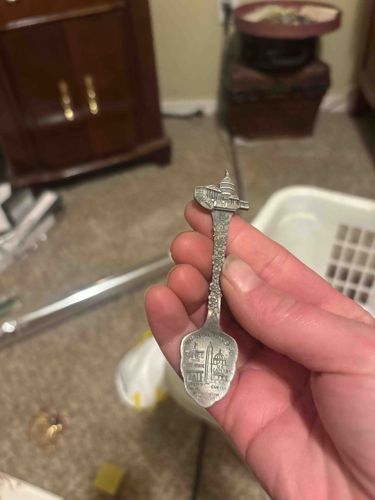
This is a silver-toned metal souvenir spoon, likely made from a non-precious metal or a low-grade silver alloy, given the lack of obvious hallmarks and the common nature of such souvenirs. The spoon is approximately 5-6 inches in length, designed with a decorative handle and a standard spoon bowl shape. The most prominent feature is the finial at the top of the handle, which depicts a three-dimensional representation of St. Peter's Basilica, complete with its iconic dome and flanking colonnades, indicating a connection to Vatican City or Rome. The handle itself is adorned with intricate floral or vine-like patterns in relief, suggesting attention to decorative detail. The bowl of the spoon is flat and features engraved or embossed images of other significant Roman landmarks. On one side, a tall, columnar structure is visible, likely an obelisk or column. On the other side, a distinct domed structure is depicted, clearly identifiable as St. Peter's Basilica from a different angle or perhaps another significant dome in Rome like the Pantheon's; however, based on the finial, St. Peter's is most probable. Below these images, faint lettering is visible, which appears to spell out 'ROMA' and 'VATICANO', confirming the geographic theme. The metal exhibits a dull, somewhat darkened patina, consistent with age and exposure, but no significant tarnish that would obscure details. There are no visible signs of damage such as bends, breaks, or significant scratches. The craftsmanship appears to be of a reasonable quality for a souvenir item, with clear detail in the castings and engravings. It likely dates from the mid-20th century to late 20th century, a popular period for the production of such travel memorabilia. The overall condition is good, showing expected signs of handling and age but no severe wear.
AI Appraisal Report
Based on my visual examination of the provided image, this souvenir spoon depicting Rome and Vatican City landmarks is in good condition, showing expected signs of age and handling, such as a dull patina, but no significant damage. Authenticity as a genuine souvenir item of its type appears high from the detailed depiction of landmarks and clear 'ROMA' and 'VATICANO' lettering. The craftsmanship is typical for a mass-produced souvenir, not indicative of fine art or precious metalwork.
Market conditions for such souvenir spoons are generally stable but with low demand, placing them in the collectible rather than high-value antique category. Comparable items, often found in online marketplaces or antique mall bins, typically sell for $10-40, depending on detail, material, and specific location. This particular spoon's clear depiction of St. Peter's Basilica and other Roman landmarks makes it a desirable example within its niche. Its non-precious metal composition (likely pot metal, pewter, or a low-grade silver alloy) significantly limits its intrinsic value. Rarity is low; these spoons were produced in vast quantities.
The primary factors impacting value are its good condition for a souvenir item and clear thematic identification. The lack of any precious metal hallmarks, confirmation of which would require in-person inspection and potential testing, prevents a higher valuation. Without physical examination, I cannot definitively confirm the metal composition or rule out the possibility of a very low-grade silver alloy (e.g., 800 silver), though the visual suggests base metal. Provenance, such as original purchase receipts or family history, would add sentimental rather than significant monetary value here. For full authentication of material purity, scientific testing like XRF analysis would be needed.