AI estimate as of November 15, 2025 · verify with a professional before acting
AI-Generated · Verify before acting
Everything on this page is generated by AI for informational purposes only. AI can make mistakes — the AI may misidentify items or misattribute them (artist, maker, brand, designer, origin, era). This is not an official valuation and should not be used for insurance, sale, tax, estate, legal, or lending purposes — or any decision requiring a certified appraisal. It is not an authoritative claim about any person, brand, or rights holder — do not share or rely on it as a factual statement about a third party. Always consult qualified professionals before making financial decisions.
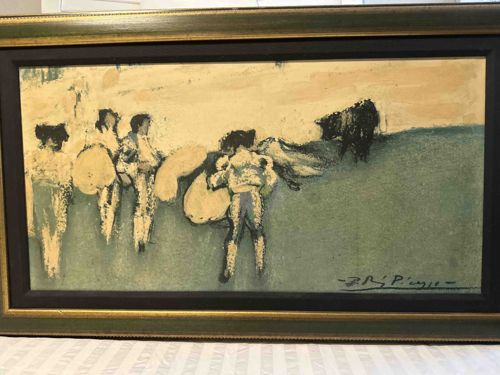
This item is an unframed lithograph or print, depicting a stylized bullfighting scene rendered in a modernist or abstract expressionist style. The artwork is characterized by a limited color palette of earthy tones, featuring shades of muted green, beige, black, and hints of pale blue or gray. The composition shows several figures, presumably matadors, standing in a line or formation, some holding what appear to be capes or large round objects, possibly shields or drums. To the right, a dark, abstract rendition of a bull is depicted, charging or standing menacingly. The brushwork or printing technique suggests a textured, almost impasto-like quality, with visible strokes and color variations that give it a sense of dynamism. The overall aesthetic is raw and energetic, typical of works influenced by early 20th-century art movements. A prominent signature, legible as "-D. R. Piccolo-" or similar, is located in the bottom right corner, suggesting it is a signed work. The print is currently housed within a black interior frame, which is then set within a wider, gilded or painted antique gold/green wooden frame. The outer frame shows some signs of wear and age, consistent with an item that has been displayed for several years; there are minor scuffs and possibly a slight darkening of the finish in places. The condition of the print itself appears good, with no obvious tears, creases, or significant discoloration visible from the image. The unique aspects include the distinct artistic style and the potential for it to be a work by a recognized artist, given the clear signature. The quality of the printing appears to be fine, capturing the nuances of the original artist's hand.
AI Appraisal Report
Based on my visual examination of the provided image, this unframed lithograph or print, depicting a modernist bullfighting scene, appears to be in good overall condition. I observe no prominent tears, creases, or significant discoloration that would detract from its aesthetic appeal. The distinctive signature, D. R. Piccolo, is a key factor, suggesting it is a signed work. While the print itself seems well-preserved, the outer gilded frame shows some wear and age-related scuffs, which is common for an item displayed for years and does not significantly impact the value of the print itself. The printing quality appears good, capturing the textured, energetic style.
From the image alone, I can assess the artistic style and apparent condition, but full authentication and confirmation of the print type (lithograph, serigraph, etc.) or artist's legitimacy would require an in-person examination. Provenance documentation, such as certificates of authenticity or acquisition records, would be crucial for verifying its history and artist attribution. Scientific testing might be needed to determine print medium with absolute certainty.
Market conditions for mid-century modernist prints by lesser-known or regional artists typically indicate a modest demand. While the artwork possesses a strong expressive quality, without established market comparables for 'D. R. Piccolo' in this style, its rarity translates more into uniqueness than high market value. Factors significantly impacting value include the art form (original lithograph vs. a print from an edition), the artist's recognition, and provenance. Given the current information, I believe this piece would fall into a decorative art category with a value primarily driven by its aesthetic appeal and the potential for it to be an original signed print within a limited edition.