AI estimate as of July 24, 2025 · verify with a professional before acting
AI-Generated · Verify before acting
Everything on this page is generated by AI for informational purposes only. AI can make mistakes — the AI may misidentify items or misattribute them (artist, maker, brand, designer, origin, era). This is not an official valuation and should not be used for insurance, sale, tax, estate, legal, or lending purposes — or any decision requiring a certified appraisal. It is not an authoritative claim about any person, brand, or rights holder — do not share or rely on it as a factual statement about a third party. Always consult qualified professionals before making financial decisions.
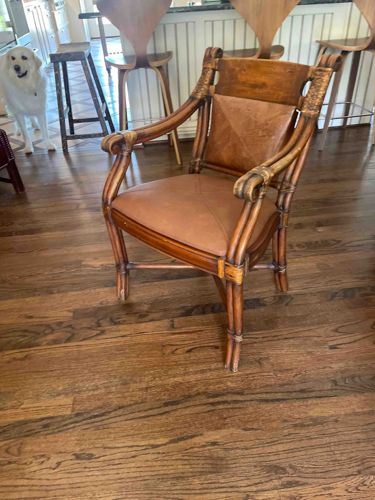
This is an armchair constructed primarily from rattan or bamboo, featuring a warm, medium-brown finish. The chair possesses a tropical or colonial revival aesthetic. Its physical characteristics include a sturdy frame made from multiple bound and curved rattan/bamboo poles, evident in the gracefully curved arms and legs. The armrests are particularly distinctive, crafted from several pieces of rattan bound together at various intervals with what appears to be natural fiber cording, possibly rattan peel or seagrass, creating a decorative and structurally reinforcing effect. The backrest consists of a solid, shaped wooden panel at the top, likely mahogany or a similar hardwood, with a rectangular upholstered panel below it. This lower back panel and the seat cushion are upholstered in a light to medium brown leather, exhibiting some natural variations in tone and texture typical of genuine leather. The leather backrest features a raised, diamond-shaped pattern in its center, adding an element of visual interest and dimensionality. The seat cushion is well-fitted with a distinct piping along its edges.
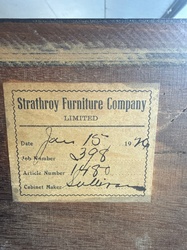
Observable condition issues include general wear consistent with age and use. There are visible scuffs and scratches on the wooden and rattan surfaces, particularly on the edges and legs. The rattan bindings show minor fraying or loosening in some areas, indicative of its natural material and age. The leather upholstery appears relatively well-maintained with some natural creasing and minor surface wear, but no major tears or significant discoloration are immediately apparent. The finish on the wood and rattan elements exhibits a subtle patina, consistent with an older piece of furniture. Manufacturing details are not immediately discernible from the image; there are no visible maker’s marks or signatures. Based on its style, materials, and construction, this chair likely dates from the mid-20th century, possibly the 1950s-1970s, aligning with periods of popularity for rattan and tropical-inspired furniture. The craftsmanship indicates a piece designed for both comfort and aesthetic appeal, with attention to the decorative binding and the integration of different materials.
AI Appraisal Report
Upon visual examination of the provided image, I assess this rattan and leather armchair as a charming example of tropical or colonial revival furniture. The condition appears consistent with a piece of its estimated age (mid-20th century, likely 1950s-1970s), exhibiting general wear, scuffs, and minor fraying of rattan bindings. The leather upholstery shows natural creasing but no significant damage. Authenticity, based solely on imagery, seems strong for a period piece of this style, given the construction details like the bound rattan poles and the integrated hardwood and leather elements.
Market conditions for vintage rattan furniture are currently stable with consistent demand, especially for well-preserved examples that blend natural materials with classic design. Comparables include pieces by designers like Paul Frankl or similar quality manufacturers from the mid-century period, though without visible maker's marks, it's categorized as 'designer-attributed' or 'in the style of.' Demand for such pieces is good among collectors and interior designers seeking unique, character-filled items. Rarity is moderate; while not a one-of-a-kind piece, its specific combination of design elements and materials is not ubiquitous.
Factors significantly impacting value include the appealing aesthetic, the use of genuine leather, and the overall integrity of the structure. The lack of a visible maker’s mark limits its top-tier collectible value, as does the general wear. For full authentication and to ascertain potential artisan origin, an in-person examination would be crucial to inspect hidden areas for marks, assess the true condition of the rattan and leather with tactile checks, and analyze the type of wood used. Provenance documentation, if available, would further enhance its value and confirm history. Scientific testing, such as carbon dating on the wood, is generally beyond the scope for such an item unless a specific, high-value attribution were being pursued.