AI estimate as of November 20, 2025 · verify with a professional before acting
AI-Generated · Verify before acting
Everything on this page is generated by AI for informational purposes only. AI can make mistakes — the AI may misidentify items or misattribute them (artist, maker, brand, designer, origin, era). This is not an official valuation and should not be used for insurance, sale, tax, estate, legal, or lending purposes — or any decision requiring a certified appraisal. It is not an authoritative claim about any person, brand, or rights holder — do not share or rely on it as a factual statement about a third party. Always consult qualified professionals before making financial decisions.
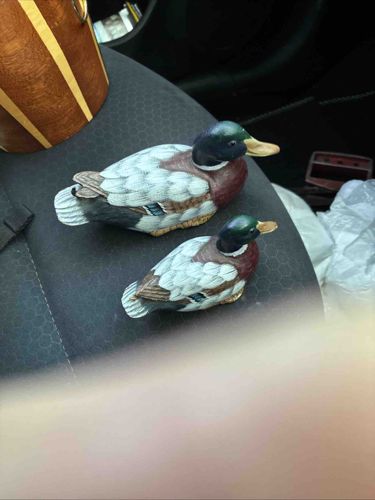
This is a pair of decorative figurines, appearing to be miniature mallard duck decoys. Both figurines are crafted in the likeness of a male mallard, distinguished by their characteristic colorful plumage. The larger duck measures approximately 5-7 inches in length, while the smaller one is roughly 4-6 inches, based on their relative size to each other and the car seat they are resting on. The construction material appears to be wood or a resin composite, given the textured surfaces and painted details. Each duck features a dark green head, a white band around the neck, a reddish-brown chest, and a body painted with light blue/gray 'feathers' on the back, brown and black wing details, and a black tail feather. The bills are depicted in a muted yellow or tan color. The painting style suggests a hand-painted finish, with visible brushstrokes adding to their artisanal appeal. The 'feathers' on the body are individually outlined, creating a textured and segmented look. No visible damage such as chips, cracks, or significant paint loss is apparent from the provided images, suggesting they are in good to very good condition. There are no discernible manufacturer's marks, signatures, or stamps visible. These items likely date from the mid-to-late 20th century to early 21st century and are common decorative pieces, possibly intended for shelf display rather than actual hunting. Their craftsmanship indicates a generally good quality for a decorative item, with attention to detail in replicating the mallard's distinct coloration.
AI Appraisal Report
I have examined the image provided for this pair of Mallard Duck Decoy Figurines. Visually, both figurines appear to be in good to very good condition, showing no significant chips, cracks, or paint loss. The paintwork, characterized by visible brushstrokes and individually outlined 'feathers,' suggests a hand-painted finish and a focus on decorative visual appeal rather than hyper-realistic hunting decoy functionality. The size differential and consistent style suggest they were sold as a set.
Market conditions for decorative duck figurines of this type are generally modest. These are common decorative items, often found in home decor stores, craft fairs, or flea markets. Comparables typically sell for low prices, reflecting their mass-produced or semi-handcrafted decorative nature. There is no indication of them being antique, rare, or from a renowned carver, which would significantly increase value. Demand for such general decorative pieces is steady but not high-value, and rarity is low.
The primary factor impacting value is their decorative utility. Without artist signatures, unique design elements, or provenance, their value hinges on their aesthetic appeal and condition. Limitations in authenticating craftsmanship from images alone are present; an in-person examination would confirm the material (wood vs. resin), the true quality of the paint application, and a thorough search for any hidden marks or signatures. Provenance documentation would be crucial to determine if they are from a known carver or era, which could elevate their value from decorative objects to collectible art. Without such information, they remain attractive, but common, decorative items.