AI estimate as of November 20, 2025 · verify with a professional before acting
AI-Generated · Verify before acting
Everything on this page is generated by AI for informational purposes only. AI can make mistakes — the AI may misidentify items or misattribute them (artist, maker, brand, designer, origin, era). This is not an official valuation and should not be used for insurance, sale, tax, estate, legal, or lending purposes — or any decision requiring a certified appraisal. It is not an authoritative claim about any person, brand, or rights holder — do not share or rely on it as a factual statement about a third party. Always consult qualified professionals before making financial decisions.
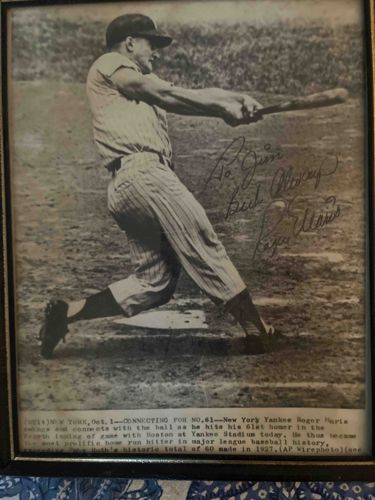
This item is a framed black and white photograph depicting New York Yankee Roger Maris in mid-swing, having just connected with the ball during his historic 61st home run. The photograph captures Maris in his pinstriped uniform, with a baseball bat extending horizontally from his hands. Visible on the photograph, superimposed over the image, is an autograph with an inscription that appears to read 'To Jim, Best Always, Roger Maris'. The image itself shows some signs of age, with slight discoloration and possibly some foxing visible in the background, typical of a vintage print. The photograph is encased in a simple, dark-colored frame, likely wood or a composite material, with a narrow profile. The frame exhibits minor wear consistent with handling and display. Below the main image, there is a printed caption, partially visible, which describes the event: 'NEW YORK, Oct. 1 — CONNECTING FOR NO. 61–New York Yankee Roger Maris...connects with the ball as he hits his 61st homer in the ...game with Boston at Yankee Stadium today. He thus became the most prolific home run hitter in major league baseball history...total of 60 made in 1927. (AP Wirephoto)'. This caption clearly dates the photograph to around October 1, 1961, making the item a significant piece of sports memorabilia from the early 1960s. The clarity of the autograph and the historical context provided by the caption add considerable value. The overall condition suggests a well-preserved piece, despite the inherent age of the photographic paper and the potential for acid migration from its mounting within the frame.
AI Appraisal Report
Upon examining the provided image of the framed Roger Maris autographed photo depicting his 61st home run, I assess its condition as good, commensurate with its age. The photograph exhibits typical vintage characteristics such as slight discoloration and possible foxing, which are not uncommon for prints from the early 1960s. The frame itself appears simple and shows minor wear, suggesting it has been displayed for some time. The autograph, 'To Jim, Best Always, Roger Maris,' appears clear and legible from the image. The historical significance of this photograph, capturing Maris's 61st home run, is immense, further bolstered by the AP Wirephoto caption providing concrete dating to October 1, 1961.
Market conditions for authentic Roger Maris memorabilia, especially items related to his 61-homer season, remain strong due to his iconic status and the enduring appeal of this record-breaking achievement. Autographed photos from this specific event are highly sought after. Comparables for authenticated Maris signed photos of this era and significance typically range from $2,500 to $6,000, depending on clarity, inscriptions, and overall condition. The personalized inscription ('To Jim') can slightly affect value, sometimes lowering it for general collectors, but not significantly for such a desirable piece.
Demand for Maris memorabilia remains consistent among baseball collectors and historical sports enthusiasts. The rarity of well-preserved, period-specific autographed pieces related to his 61st home run contributes to its value. Factors significantly impacting value include the historical context, the clear image of Maris in action, and the apparent legibility of the autograph.
It is crucial to note the limitations of authenticity verification from images alone. While the autograph appears consistent with known examples of Roger Maris's signature, definitive authentication would require in-person examination by a reputable third-party authenticator (e.g., PSA/DNA, JSA). This would allow for a thorough examination of ink consistency, pressure points, and comparison with known exemplars. Additionally, physical inspection would allow for a closer assessment of the photograph's print type, paper quality, and the extent of any age-related damage or potential restoration, which could not be fully determined from the provided image. Provenance documentation, if available, could also enhance confidence in the item's authenticity and history.