AI estimate as of October 4, 2025 · verify with a professional before acting
AI-Generated · Verify before acting
Everything on this page is generated by AI for informational purposes only. AI can make mistakes — the AI may misidentify items or misattribute them (artist, maker, brand, designer, origin, era). This is not an official valuation and should not be used for insurance, sale, tax, estate, legal, or lending purposes — or any decision requiring a certified appraisal. It is not an authoritative claim about any person, brand, or rights holder — do not share or rely on it as a factual statement about a third party. Always consult qualified professionals before making financial decisions.
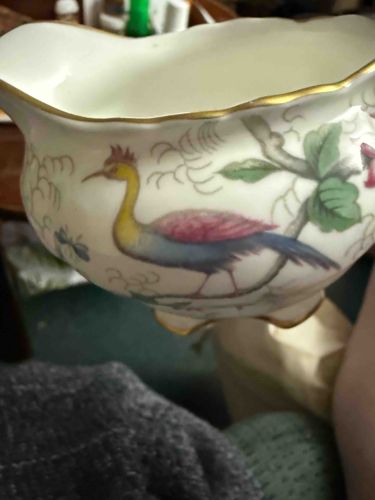
The item appears to be a porcelain sauce boat or creamer, characterized by its boat-like shape and spout, although the full spout is not clearly visible in the provided image. It is crafted from fine, light-colored porcelain or bone china, exhibiting a slightly off-white or cream background color. The rim of the vessel is irregularly scalloped or wavy, adding an elegant detail, and is highlighted with a delicate gold gilt border, indicating a degree of quality and decorative intent. The primary decoration is a polychrome Chinoiserie-style motif featuring a fantastic bird with a yellow neck and head, a red crest, and distinct blue and pink plumage on its body and wings. This bird stands on one leg, seemingly perched on a stylized branch or ground line. Surrounding the bird are elements of a landscape, including green leaves, brown branches, and what appears to be a smaller, delicate insect (possibly a fly or butterfly) in flight nearby. The artistic style of the decoration suggests an origin from the 18th to early 20th century, a period when Chinoiserie patterns were highly popular in European ceramics. The craftsmanship appears to be of good quality, with clear, vibrant overglaze enamels applied with a fine hand. There are no obvious signs of chips, cracks, or significant repair, though closer inspection of the gilding and base would be necessary to assess wear and any potential restorations fully. The lustrous surface and detailed hand-painting indicate a piece designed for aesthetic appeal and likely part of a larger dinnerware or tea set.
AI Appraisal Report
Upon visual examination of the provided image, this porcelain sauce boat or creamer presents as a charming example of Chinoiserie-style tableware. The vessel's form, with its scalloped gilt rim and elegant boat-like shape, suggests an 18th to early 20th-century European manufacture, a period when such exotic motifs were highly fashionable. The polychrome decoration featuring a fantastic bird with vibrant yellow, red, blue, and pink plumage, set amidst green foliage and brown branches, is characteristic of the Chinoiserie aesthetic. The enamels appear well-preserved and brightly colored, applied with a fine hand, indicating good quality craftsmanship.
Condition appears to be excellent from the image; I observe no obvious chips, cracks, or significant losses to the overglaze enamels. The gilding on the rim seems largely intact, though minor wear consistent with age and use is to be expected and cannot be fully assessed without a physical inspection. The lustrous surface finish supports good preservation.
In terms of market conditions, Chinoiserie porcelain, particularly well-decorated pieces in good condition, generally maintains a steady demand among collectors. Comparables would include similar European porcelain creamers or sauce boats from manufacturers like Meissen, Chelsea, or Worcester, or other continental factories producing Chinoiserie decorated wares. Rarity is moderate for a single piece; a complete set would command significantly more.
Factors impacting value include the attractive design, vibrant colors, and apparent good condition. However, without inspecting the base for maker's marks or factory stamps, confirming authenticity to a specific, high-value factory is impossible. Physical examination would also reveal any hidden repairs, true condition of the gilding, and the quality of the paste. Scientific testing, such as spectroscopy, could confirm the age of the materials. Without in-person authentication and proven provenance, the valuation remains conservative.