AI Appraisal Estimate

AI-generated estimates · not official valuations

From the user

What was submitted

Photo and notes provided by the user — not generated by AI

Submitted item photo
Submitted photo · June 6, 2026

User's notes

No additional notes provided.

AI analysis below

AI appraisal

AI analysis & estimate

AI-Generated · Verify before acting

Everything below is generated by AI for informational purposes only. AI can make mistakes — the AI may misidentify items or misattribute them (artist, maker, brand, designer, origin, era). This is not an official valuation and should not be used for insurance, sale, tax, estate, legal, or lending purposes — or any decision requiring a certified appraisal. It is not an authoritative claim about any person, brand, or rights holder — do not share or rely on it as a factual statement about a third party. Always consult qualified professionals before making financial decisions.

Read the full disclaimer

AI Identification

·Not independently authenticated·Verify before acting

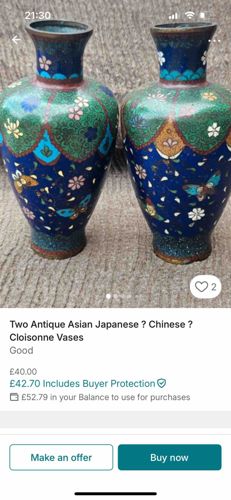
Pair of Antique Asian Cloisonné Vases

Decorative Arts

AI Estimated Value

·Not an official valuation·Verify before acting

$400-600

As of June 6, 2026

AI Item Analysis

·AI can make mistakes·Verify before acting
This is a pair of antique or vintage cloisonné vases, exhibiting intricate enamel work on a metal body, likely copper or bronze. Each vase stands approximately 6-8 inches tall, with a bulbous body that tapers towards a flared neck and a narrow base. The primary color scheme is a vibrant cobalt blue, serving as the background for delicate floral and butterfly motifs. The upper shoulder of each vase features a band of intricate green enamel work, adorned with small white and pink blossoms. Below this, there's another band with segmented patterns in shades of blue, teal, and gold, indicative of stylized cloud or wave patterns. The main body of the vases showcases a scattering of colorful flowers in white, pink, and red, along with several butterflies in various hues like yellow, blue, and brown. The cloisonné technique is evident in the fine metal wires (cloisons) that create the outlines for the enamel cells, which are then filled with colored vitreous paste and fired. The surface appears to have a slight aged patina, consistent with antique items, and the metal edges of the rim and base show some wear, revealing the underlying metal. There are no immediately visible chips or cracks in the enamel, suggesting good preservation, but detailed inspection would be needed to confirm. The craftsmanship suggests a high level of detail and patience. While the exact origin (Japanese or Chinese) is not definitively discernible from the image, both traditions are well-known for producing high-quality cloisonné. The overall aesthetic points towards an early to mid-20th-century period, but could potentially be older depending on closer examination of the base and any hidden marks. The slightly uneven surface and subtle variations between the two vases suggest handmade production.
AI Appraisal Report

·AI can make mistakes·Verify before acting
I have examined the image provided of this pair of antique Asian cloisonné vases. Visually, the condition appears to be very good; I see no immediate chips or cracks in the enamel, which is crucial for cloisonné value. The aged patina and wear on the metal edges are consistent with their likely age and suggest authenticity rather than modern reproduction. The intricate floral and butterfly motifs on the vibrant cobalt blue background, alongside the detailed banding, point to skilled craftsmanship. The slight variations between the two vases indicate handmade production. Based on the visible craftsmanship and condition, these vases likely fall into the early to mid-20th century. Authenticity verification from images alone is limited; I cannot assess the presence of repair, internal integrity, or the quality of the base metal. Definitive attribution to Chinese or Japanese origin would require in-person examination, particularly of the base for maker's marks, and possibly microscopic analysis of the enamels. Provenance documentation, if available, would significantly enhance authentication and value. In terms of market conditions, antique Asian decorative arts, particularly well-preserved cloisonné, maintain consistent demand. Comparable sales for similar quality pieces of this size and period typically range from modest to mid-hundreds. Factors significantly impacting value include the precise origin (e.g., specific Imperial workshops), rarity of the design, and confirmed lack of restoration. Without physical inspection and further research, I'm basing this on general market trends for good quality, unmarked cloisonné. Rarity is moderate for items of this period; while not one-of-a-kind, a well-preserved pair is more desirable than singles. The vibrant blue and detailed work are appealing to collectors.

Get your items appraised

Instant estimates of your treasures with AI-powered appraisals

Browse More Appraisals