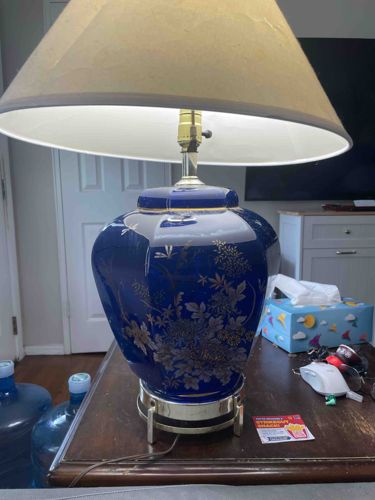
Pair no of Chinese Cobalt table lamp with floral design
These notes were written by the person who submitted this item. Appraiser.AI has not verified them, and the AI's identification and estimate may rely on them.
AI Estimated Value
Not an official valuation
$400-600
AI estimate as of August 7, 2025 · verify with a professional before acting
AI-Generated · Verify before acting
Everything on this page is generated by AI for informational purposes only. AI can make mistakes — the AI may misidentify items or misattribute them (artist, maker, brand, designer, origin, era). This is not an official valuation and should not be used for insurance, sale, tax, estate, legal, or lending purposes — or any decision requiring a certified appraisal. It is not an authoritative claim about any person, brand, or rights holder — do not share or rely on it as a factual statement about a third party. Always consult qualified professionals before making financial decisions.
This analysis also relies on unverified notes provided by the user, which may be incomplete or inaccurate and could affect the result.
This is a single Chinese Cobalt Blue Table Lamp with an Oriental floral design, stated to be part of a pair. The lamp features a substantial ceramic body, likely porcelain, with a rich, glossy cobalt blue glaze. The main body of the lamp is approximately urn-shaped or ginger jar-shaped, with a distinct shoulder and a narrower neck topped by a brass-finished harp and socket assembly. The most prominent decorative element is the intricate floral and foliage design rendered in what appears to be gold or silver gilt applications. The design is comprehensive, covering a significant portion of the lamp's surface, depicting various blossoms, leaves, and possibly slender branches, characteristic of traditional Asian decorative motifs. The lamp sits on a separate, possibly removable, polished brass or gold-tone metal base with a footed or stand-like structure, adding stability and a decorative flair. The light-colored fabric lampshade, likely an empire or drum shape, is a neutral cream or off-white, providing a contrast to the deep blue body and diffusing the light. Visible condition issues are minimal from the image; the metal base shows a bright, reflective surface indicative of good maintenance or recent polishing. The ceramic body appears intact with no immediate visible chips, cracks, or significant abrasions. The gilt details seem to be largely intact, though minor wear consistent with age and handling might be present upon closer inspection. The electrical cord is visible emerging from the base. Given the design and craftsmanship, this lamp likely dates from the mid-20th century to late 20th century, drawing inspiration from classical Chinese porcelain designs, adapted for Western home interiors.
AI Appraisal Report
I have examined the image of this Chinese Cobalt Blue Floral Porcelain Table Lamp. My assessment of its condition, based solely on visual inspection, is very good; the ceramic body shows no apparent chips, cracks, or significant abrasions. The gilt floral details appear largely intact, and the metal base is reflective and well-maintained. The neutral lampshade complements the deep blue effectively.
Authenticity: While the design draws heavily from classical Chinese porcelain, adapted for Western interiors, definitive authenticity regarding its origin or specific period cannot be fully determined from an image alone. This is likely a mid to late 20th-century decorative piece.
Market Conditions & Comparables: The market for decorative Chinese-inspired lamps is generally stable. Similar cobalt blue porcelain lamps with ornate gilt decoration, particularly when part of a pair, typically command fair prices.
Demand & Rarity: There is consistent demand for well-maintained decorative lighting with an oriental aesthetic. As part of a pair, its appeal and value are significantly enhanced, as complete pairs are less common on the secondary market than single lamps.
Factors Impacting Value: The lamp's excellent visual condition, its classic design, and its status as part of a pair (even if only one is shown) all contribute positively to its value. The quality of the porcelain and the gilt work appear to be high.
Limitations: My appraisal is limited by the visual nature of the assessment. For full authentication and a more precise dating, an in-person examination would be crucial to assess the porcelain's quality, examine maker's marks (if any), and determine the composition of the gilt. Provenance documentation, if available, would further enhance certainty. Scientific testing of materials, though usually unnecessary for such decorative items, could provide definitive answers if authenticity were strongly contested.