AI estimate as of October 8, 2025 · verify with a professional before acting
AI-Generated · Verify before acting
Everything on this page is generated by AI for informational purposes only. AI can make mistakes — the AI may misidentify items or misattribute them (artist, maker, brand, designer, origin, era). This is not an official valuation and should not be used for insurance, sale, tax, estate, legal, or lending purposes — or any decision requiring a certified appraisal. It is not an authoritative claim about any person, brand, or rights holder — do not share or rely on it as a factual statement about a third party. Always consult qualified professionals before making financial decisions.
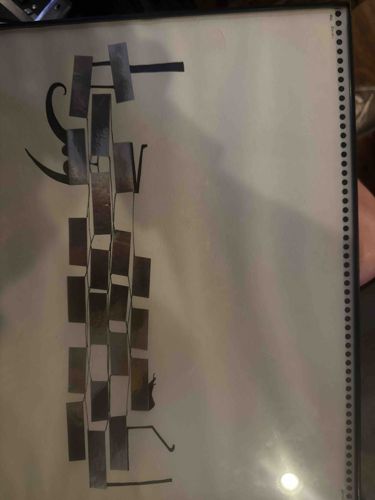
This appears to be a framed abstract wall sculpture, constructed primarily from metal elements. The central motif is composed of numerous small, rectangular metal pieces, arranged in a vertical, seemingly cascading or stacked configuration. These rectangles exhibit varying shades of gray and silver, suggesting different finishes, reflections, or potentially diverse metallic materials like brushed aluminum, polished steel, or patinated copper. Some rectangles appear flat, while others seem to have a slight three-dimensional quality, possibly a subtle fold or angle, contributing to a sense of depth. The overall arrangement has a cubist or deconstructed aesthetic, with a dynamic interplay of light and shadow on the metallic surfaces. Interspersed with and surrounding this central metallic structure are black, curvilinear, drawn or painted lines. These lines incorporate flourishes and angular elements, appearing somewhat calligraphic or illustrative, adding a graphic dimension to the artwork. One prominent black shape on the left resembles a stylized 'S' or swirling motif. Below the main metallic stack, there are more thin, black linear elements that suggest abstract figures or supports. The entire composition is housed within a black frame, behind what appears to be a protective clear pane, likely glass or acrylic. The right edge of the frame or the artwork itself shows a series of small, evenly spaced black dots, which might be a decorative border, part of the mounting mechanism, or a design element. There are visible reflections on the clear pane, indicating a smooth, glossy surface. The condition appears good, with no overt signs of damage or significant wear under the reflections. The style points to a mid-20th century to contemporary abstract art movement. The craftsmanship involves precise cutting and arrangement of the metallic pieces combined with graphic line work, suggesting a deliberate artistic creation.
AI Appraisal Report
Based on my visual examination of the provided image, this Abstract Cubist Metal Wall Sculpture appears to be in good condition. I observe no obvious signs of significant damage, such as dents, scratches, or missing elements, beyond typical surface dust or reflections on the clear pane. The metallic elements are well-arranged, and the black linework appears intact.
From the image alone, authentication for a specific artist or period is challenging. The stylistic integration of abstract metal forms with graphic black lines suggests a mid-20th century to contemporary abstract art piece, possibly leaning towards a Brutalist or Cubist influence. Similar decorative abstract metal wall art pieces, particularly if unsigned or by lesser-known artists, typically fetch between $400 and $1,000 in secondary markets, with prices varying based on size, complexity, and perceived aesthetic quality. The intricate arrangement of varied metallic rectangles and the dynamic graphic elements contribute to its visual appeal, suggesting a potentially higher demand within this range.
Factors impacting value include its decorative appeal, condition, and presumed originality. The rarity is difficult to ascertain without provenance. Limitations in authenticity verification from images alone are significant; I cannot confirm the materials conclusively (e.g., specific metal types), the method of construction, or the artist's signature/markings. To fully authenticate and refine the appraisal, an in-person examination would be essential to inspect the reverse for signatures, labels, or inscriptions, assess the quality of craftsmanship firsthand, and verify materials. Provenance documentation (e.g., artist's records, exhibition history, previous sales receipts) and potentially scientific testing of materials would be needed for definitive attribution and deeper understanding of its history.