AI identification & appraisal estimate

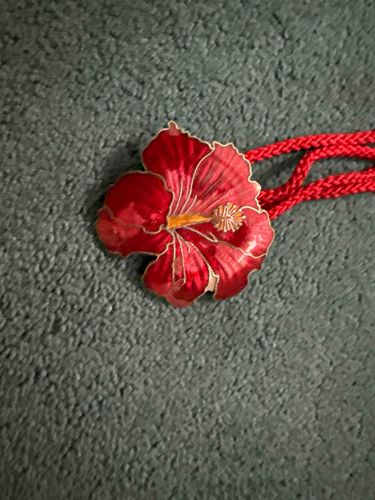
Red Hibiscus Enamel Pendant Necklace

This name is the AI's identification of the item — it may be incorrect.

Submitted photo of Red Hibiscus Enamel Pendant Necklace
Photo submitted by the user — not generated by AI

AI Estimated Value

Not an official valuation

$25-50

AI estimate as of October 27, 2025 · verify with a professional before acting

AI-Generated · Verify before acting

Everything on this page is generated by AI for informational purposes only. AI can make mistakes — the AI may misidentify items or misattribute them (artist, maker, brand, designer, origin, era). This is not an official valuation and should not be used for insurance, sale, tax, estate, legal, or lending purposes — or any decision requiring a certified appraisal. It is not an authoritative claim about any person, brand, or rights holder — do not share or rely on it as a factual statement about a third party. Always consult qualified professionals before making financial decisions.

Read the full disclaimer

AI Item Analysis

This item is a vibrant red hibiscus flower pendant attached to a red braided cord, forming a necklace. The pendant depicts a hibiscus in full bloom, featuring five distinct petals. The petals are rendered in a rich, glossy red enamel, with lighter pink-red hues and white outlines that suggest the natural folds and veins of a flower. The edges of the petals are outlined in a metallic silver or white tone, which also defines the central veins. In the center of the flower, the stamen and pistil are intricately detailed in a yellow-gold color, featuring a textured, almost granulated appearance that mimics the floral anatomy. The overall construction appears to be cloisonné or champlevé enamel work on a metallic base, likely a base metal given the lack of specific hallmarks, though the reflective quality suggests silver-plated or a similar alloy for the metalwork outlines. The pendant's dimensions are roughly consistent with a medium-sized statement piece, appearing approximately 1.5 to 2 inches in diameter based on its relation to the braided cord. The red braided cord is a simple, uniform plait, matching the dominant color of the flower, and appears to be made of a textile material like silk or rayon. The condition appears good, with no obvious chips or cracks in the enamel visible from the image. The glossy finish of the enamel is well-preserved, indicating good care or relatively recent manufacture. This style of floral enamel jewelry was popular in various periods, including the mid-20th century, but continues to be produced, making an exact age difficult without further markings. It is a mass-produced item rather than a unique artisan piece, suggesting a more decorative and fashion-oriented purpose.
AI Appraisal Report

Based on my visual examination of the provided image, this Red Hibiscus Enamel Pendant Necklace appears to be in good condition. The glossy red enamel is well-preserved with no discernable chips, cracks, or significant abrasions. The metallic outlines and central detailing in yellow-gold also appear intact. Authenticity, in this context, relates more to the material and manufacturing process than a singular named artisan or brand. The item is consistent with mass-produced cloisonné or champlevé style enamel jewelry, likely featuring a base metal with silver-plated or similar alloy outlining. The red braided cord is a fashion-oriented material, further supporting its decorative, non-fine jewelry classification. Market conditions for fashion jewelry of this type are generally stable but do not command high prices. Comparables, found in online marketplaces and craft fairs, typically range from $20 to $60 for new or excellent condition pieces. Demand for floral enamel pendants is consistent, appealing to a broad demographic looking for an eye-catching accessory. However, given its mass-produced nature and the materials used, rarity is not a factor; similar items are readily available. The primary factors impacting value are its good condition and attractive design. The lack of precious metals or gemstones, along with its likely machine-assisted enamel application, limits its intrinsic value. Were this a genuine handcrafted cloisonné piece from a prominent artisan or brand, the value would be significantly higher. Without an in-person examination, verifying the exact base metal composition and the precise technique of enamel application (e.g., true cloisonné with individually soldered wires versus an impressed pattern filled with enamel) is impossible. Additionally, the specific material of the braided cord (e.g., silk vs. synthetic) cannot be definitively determined from imagery alone. These details, while minor, would offer more precision in material cost assessment but are unlikely to dramatically alter the overall contemporary accessory market valuation.

Keep exploring

More jewelry appraisals

Get your items appraised

Instant AI-powered appraisal estimates from a photo

Browse More Appraisals