AI Appraisal Estimate

AI-generated estimates · not official valuations

From the user

What was submitted

Photo and notes provided by the user — not generated by AI

Submitted item photo
Submitted photo · May 27, 2026

User's notes

Mother of pearl

AI analysis below

AI appraisal

AI analysis & estimate

AI-Generated · Verify before acting

Everything below is generated by AI for informational purposes only. AI can make mistakes — the AI may misidentify items or misattribute them (artist, maker, brand, designer, origin, era). This is not an official valuation and should not be used for insurance, sale, tax, estate, legal, or lending purposes — or any decision requiring a certified appraisal. It is not an authoritative claim about any person, brand, or rights holder — do not share or rely on it as a factual statement about a third party. Always consult qualified professionals before making financial decisions.

Note

This analysis also relies on unverified notes provided by the user, which may be incomplete or inaccurate and could affect the result.

Read the full disclaimer

AI Identification

·Not independently authenticated·Verify before acting

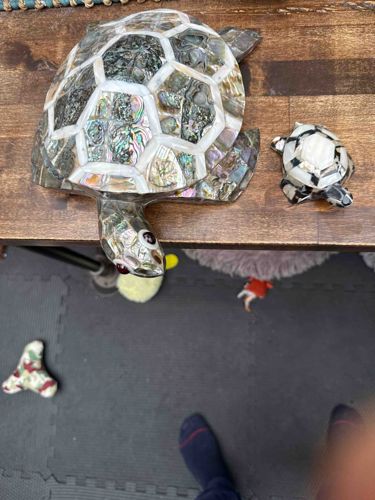
Artisanal Abalone and Mother of Pearl Inlaid Turtle Figurines

Decorative Collectibles / Shell Art

AI Estimated Value

·Not an official valuation·Verify before acting

$150 - $250

As of May 27, 2026

AI Item Analysis

·AI can make mistakes·Verify before acting
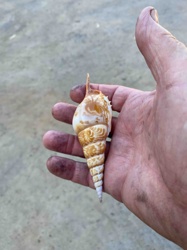
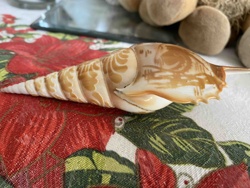
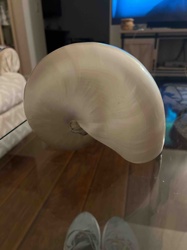
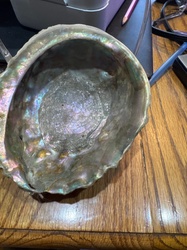
This set consists of two turtle figurines of varying sizes, meticulously handcrafted with intricate shell inlay. The larger turtle features a prominent carapace constructed using a mosaic of iridescent abalone shell pieces, displaying a vibrant spectrum of greens, blues, and pinks. These are bordered by creamy white mother of pearl strips that simulate the natural scutes of a turtle's shell. The head, neck, and flippers are similarly adorned with shell fragments, with small dark beads or stones integrated to represent the eyes. The smaller turtle follows a similar design language but utilizes a more monochromatic contrast of dark nacre and bright white mother of pearl in a high-contrast geometric pattern. The construction likely involves a resin or wood substrate upon which the thin shell veneers are applied and then polished to a high gloss finish. No visible maker’s marks are present in the image, but the style is characteristic of mid-to-late 20th-century decorative shellwork common in coastal artisan regions. The condition appears excellent with no visible missing inlay or significant cracking, though fine surface scratches consistent with handling may be present upon closer inspection. The quality of the joinery and the refraction of the shells indicate skilled craftsmanship.
AI Appraisal Report

·AI can make mistakes·Verify before acting
I have examined the images of these two artisanal turtle figurines. The pair exhibits the high-gloss aesthetic and labor-intensive inlay techniques associated with mid-to-late 20th-century shellwork, likely hailing from skilled workshops in the Philippines or Mexico. The larger specimen showcases vibrantly colored Abalone (paua) with its signature iridescence, while the smaller piece utilizes high-contrast Mother of Pearl and dark nacre to simulate natural scutes. The condition is noted as excellent; I observe no significant loss of tesserae or lifting of the veneer, which is common in older resin-based shell art. The lack of visible maker's marks is typical for these decorative collectibles, prioritizing the material over a brand name. Market demand for shell art remains stable within the tropical and nautical decor sectors. Similar sets frequently sell at auction or in boutique vintage shops within the $150 to $250 range, depending on the venue. Value is driven by the size of the pieces and the lack of damage to the polished surface. However, my assessment is limited by the digital format. Without physical inspection, I cannot confirm the integrity of the internal substrate (resin vs. wood) or detect microscopic fractures in the shell layers. To provide a definitive authentication, I would require an in-person examination to verify the depth of the polish and any provenance documentation showing the origin of the artisanal workshop. No scientific testing is required for this classification of decorative art.

Get your items appraised

Instant estimates of your treasures with AI-powered appraisals

Browse More Appraisals