AI estimate as of September 27, 2025 · verify with a professional before acting
AI-Generated · Verify before acting
Everything on this page is generated by AI for informational purposes only. AI can make mistakes — the AI may misidentify items or misattribute them (artist, maker, brand, designer, origin, era). This is not an official valuation and should not be used for insurance, sale, tax, estate, legal, or lending purposes — or any decision requiring a certified appraisal. It is not an authoritative claim about any person, brand, or rights holder — do not share or rely on it as a factual statement about a third party. Always consult qualified professionals before making financial decisions.
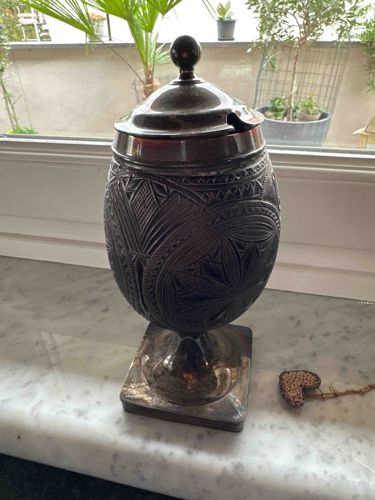
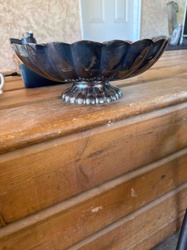
This appears to be a decorative container, likely intended for use as a sugar bowl, jam pot, or similar condiment holder, notable for its intricately carved body. The main body of the container is crafted from a dark, organic material, most likely a gourd, which has been extensively hand-carved with a variety of geometric and stylized floral or leaf patterns. The carving is deep and detailed, creating a textured surface that catches the light. The patterns include cross-hatching, starburst-like motifs, and interlocking geometric shapes arranged in vertical panels around the ovoid body. The color of the carved body is a deep, rich brown, suggesting either the natural color of the gourd or an intentional staining/polishing process.
The container is fitted with silver-toned metal components at the top and bottom. The lid is a domed metal piece, featuring a spherical finial at its apex for easy lifting. A small notch or cutout on the rim of the lid indicates it is designed to accommodate a spoon or ladle, which is visible resting within this slot. The metal appears to be tarnished, displaying a darkened patina consistent with age and exposure, suggesting it could be silver, silver-plated, or pewter. The base consists of a metal foot with a central stem supporting the gourd, flaring out to a square, stepped platform. This base also exhibits significant tarnishing, particularly on its flat surfaces. The overall construction suggests a marriage of natural craftsmanship with metalwork, indicating a potentially folk art or artisanal origin. The condition shows visible wear and heavy tarnish on the metal parts, which is typical for older pieces and could be cleaned, though some collectors prefer the aged patina. Based on the style and craftsmanship, this item could date from the late 19th to early 20th century. No visible maker's marks or signatures are discernible from the image.
AI Appraisal Report
I have examined the image of this Carved Gourd Container with Metal Fittings. Visually, its authenticity as an artisanal or folk art piece from the late 19th to early 20th century appears consistent with the described features. The intricate hand-carving on the gourd is detailed and expressive, indicating skilled craftsmanship. The metal fittings, with their significant tarnishing and style, corroborate the suggested age. The design, incorporating a notch for a spoon, points to its likely use as a sugar bowl or jam pot. The condition shows wear consistent with age and use, particularly the heavy tarnish on the metal components, which is expected for such an item. Some collectors may prefer the aged patina, while others might clean it.
In terms of market conditions, similar folk art or artisanal decorative containers, particularly those combining natural materials with metalwork, can attract collectors interested in ethnographic pieces or unique tableware. Demand is moderate, driven by niche collectors rather than broad appeal. Rarity is difficult to assess without knowing the origin, but similar unique pieces are not mass-produced, lending some scarcity. Factors impacting value significantly include the quality and intricacy of the carving, which is very good here, and the material of the metal fittings. If the metal is sterling silver, the value would be higher; if it's pewter or plated base metal, the value would be in the range I've estimated.
It is crucial to note the limitations of image-based appraisal. While I can confirm the visual consistency with the stated period and materials, definitive authentication of the metal composition (e.g., sterling silver vs. silver plate vs. pewter) requires in-person examination or testing. The absence of maker's marks is common for folk art but makes identification of origin or specific artisan difficult. Full authentication would benefit from detailed in-person inspection, specific gravity tests for metal composition, and any available provenance documentation.