AI estimate as of December 6, 2025 · verify with a professional before acting
AI-Generated · Verify before acting
Everything on this page is generated by AI for informational purposes only. AI can make mistakes — the AI may misidentify items or misattribute them (artist, maker, brand, designer, origin, era). This is not an official valuation and should not be used for insurance, sale, tax, estate, legal, or lending purposes — or any decision requiring a certified appraisal. It is not an authoritative claim about any person, brand, or rights holder — do not share or rely on it as a factual statement about a third party. Always consult qualified professionals before making financial decisions.
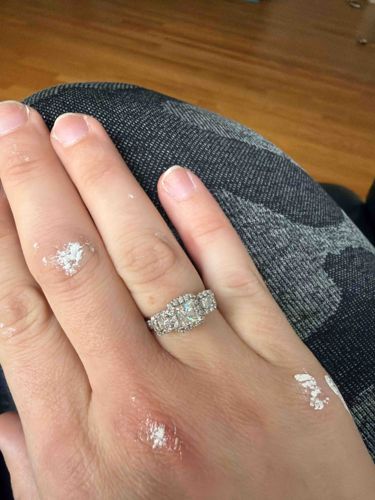
The item is a three-stone diamond ring, prominently featuring a central square or princess-cut diamond flanked by two slightly smaller, similarly shaped diamonds. Each of these three main stones is surrounded by a halo of smaller, round brilliant-cut diamonds, enhancing their perceived size and brilliance. The band of the ring also appears to be adorned with pavé-set diamonds along its shoulders, extending perhaps half to three-quarters of the way around the circumference based on the visible portion. The metal is a bright, silvery-white, consistent with white gold, platinum, or palladium. The overall construction suggests a modern engagement or anniversary ring style, characterized by its elaborate diamond setting and significant sparkle. The craftsmanship appears to be of good quality, with diamonds uniformly set and the metalwork creating a seamless, glittering surface. No visible damage or repairs are discernible, though the angles and resolution do not allow for a microscopic inspection. The ring is worn on the ring finger of a person whose hand shows some white specks, possibly paint or gypsum, which are irrelevant to the assessment of the ring itself. The general aesthetic points towards a contemporary design, likely from the late 20th or early 21st century.
AI Appraisal Report
Based on my visual examination of the provided image, I assess this three-stone diamond ring with pavé setting. The ring features a central square or princess-cut diamond, flanked by two slightly smaller, similarly-cut diamonds. Each of these main stones is encompassed by a halo of smaller, round brilliant-cut diamonds, significantly enhancing their visual impact and brilliance. The band itself is adorned with pavé-set diamonds along the shoulders, contributing to the ring's overall dazzling aesthetic. The bright, silvery-white metal is consistent with white gold or platinum, which are ideal choices for showcasing diamonds. The overall condition appears excellent, with all diamonds uniformly set and no visible damage or repairs. The craftsmanship evident in the intricate setting suggests a high-quality piece. This style is quite popular in contemporary engagement and anniversary jewelry, indicative of a modern design from the late 20th or early 21st century.
Market conditions for multi-stone diamond rings, especially those with halos, are strong due to their perceived value and brilliant appearance. Comparables in the market selling similar designs, assuming natural diamonds of good quality (VS1-SI2 clarity, G-I color) and a total carat weight (TCW) of approximately 1.5 to 2.5 carats across all stones, would command prices in the range I've provided. Demand for such elaborate and sparkly rings remains consistently high.
Factors significantly impacting value include the total carat weight, color, clarity, and cut quality of all diamonds, as well as the purity and weight of the precious metal. Without physical inspection, I cannot ascertain the precise carat weight, color, or clarity of the diamonds, nor confirm if they are natural or lab-grown, or if the metal is 14k/18k white gold or platinum. These elements are crucial for a definitive valuation. A full authenticity verification would require in-person examination by a gemologist, including microscopic analysis, precise measurement of all stones, and potentially laboratory testing for diamond origin (natural vs. lab-grown) and metal assay. Documentation such as a GIA or equivalent grading report for the main diamonds would also significantly enhance the accuracy of an appraisal.