These notes were written by the person who submitted this item. Appraiser.AI has not verified them, and the AI's identification and estimate may rely on them.
AI Estimated Value
Not an official valuation
$25-75
AI estimate as of December 5, 2025 · verify with a professional before acting
AI-Generated · Verify before acting
Everything on this page is generated by AI for informational purposes only. AI can make mistakes — the AI may misidentify items or misattribute them (artist, maker, brand, designer, origin, era). This is not an official valuation and should not be used for insurance, sale, tax, estate, legal, or lending purposes — or any decision requiring a certified appraisal. It is not an authoritative claim about any person, brand, or rights holder — do not share or rely on it as a factual statement about a third party. Always consult qualified professionals before making financial decisions.
This analysis also relies on unverified notes provided by the user, which may be incomplete or inaccurate and could affect the result.
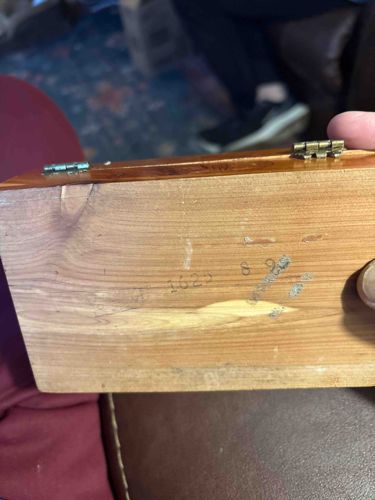
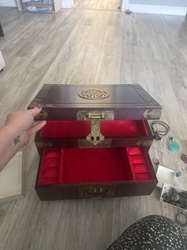
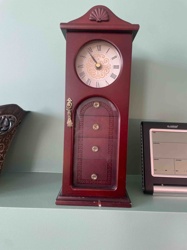
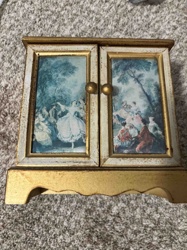
This appears to be a small rectangular jewelry box, crafted from cedar wood, showcasing its characteristic reddish-brown hue and prominent grain patterns. The top surface of the box, visible along the upper edge, has a richer, more finished appearance, suggesting a clear coat or varnish, which contrasts with the raw, unfinished or less-finished look of the side panels. The construction appears to be simple, likely dovetailed or butt-jointed, though the exact joinery is not clearly visible in this perspective. Two brass-colored metal hinges are visible, securing the lid to the main body of the box, one on the left and another on the right, indicating a functional, opening lid. The metal of the hinges shows some signs of patina or discoloration consistent with age or use.
Crucially, the side of the box features stamped or possibly branded markings: '1625' and '8 9'. Given the additional context provided (Cedar jewelry box, 1625. 8 9 stamped on back), these numbers likely represent a manufacturing date or a serial/batch number in conjunction with a date. The '1625' could indicate the year of manufacture if it's a very old piece, or more commonly, it might be a model number or a measurement in contemporary production. However, if '1625' truly refers to the year, it suggests an extremely rare and valuable antique, which would be highly unusual for a cedar jewelry box of this apparent style. More realistically, '1625' could be part of a contemporary numbering system, with '8 9' potentially indicating August 19xx or September of a given year. The wood itself shows natural variations and some light surface wear, minor scuffs, and possibly some residue or discoloration around the stamped numbers, indicating its used condition. The overall craftsmanship suggests a functional, possibly mass-produced, item rather than a unique artisan piece, unless further details suggest otherwise. The cedar wood is a common choice for such boxes due to its pleasant aroma and insect-repelling properties.
AI Appraisal Report
Based on my visual examination of the provided image, this cedar jewelry box appears to be a functional, likely mass-produced item. The characteristic reddish-brown cedar wood with visible grain, coupled with simple construction and brass-colored hinges showing some patina, suggests a modest vintage or contemporary piece. The condition is consistent with normal use, exhibiting light surface wear, minor scuffs, and discoloration around the stamped numbers. Authenticity as a genuine cedar box is supported by the visual characteristics of the wood.
The crucial '1625' and '8 9' markings on the side are open to interpretation. Given the style, an actual manufacturing date of 1625 is highly improbable; such a piece would exhibit vastly different construction, materials, and wear patterns consistent with extreme age, none of which are evident. It is far more plausible that '1625' is a model or batch number, and '8 9' could denote a date like August 19xx or a similar internal numbering system. This interpretation aligns with market comparables for antique or vintage cedar boxes, which typically fetch between $20 and $100 depending on condition, size, and specific provenance. Demand for such functional, unadorned cedar boxes is generally low to moderate, with rarity not being a significant factor unless provenance links it to a specific historical event or artisan.
Factors impacting value include its functional condition, the appeal of cedar wood, and the ambiguity of the markings. Without physical inspection, I cannot definitively confirm wood type, exact construction methods, or the precise nature of the markings. An in-person examination would allow for closer inspection of joinery, wood grain, and the application of the stamps. Provenance documentation could clarify the meaning of the numbers and provide a concrete manufacturing date. Scientific testing might confirm wood age, but for an item of this type, it's rarely justifiable economically. Given these limitations, and assuming a common interpretation of the markings, I estimate its value to be in the range of $25-75.