AI Appraisal Estimate

AI-generated estimates · not official valuations

From the user

What was submitted

Photo and notes provided by the user — not generated by AI

Submitted item photo
Submitted photo · June 8, 2026

User's notes

No additional notes provided.

AI analysis below

AI appraisal

AI analysis & estimate

AI-Generated · Verify before acting

Everything below is generated by AI for informational purposes only. AI can make mistakes — the AI may misidentify items or misattribute them (artist, maker, brand, designer, origin, era). This is not an official valuation and should not be used for insurance, sale, tax, estate, legal, or lending purposes — or any decision requiring a certified appraisal. It is not an authoritative claim about any person, brand, or rights holder — do not share or rely on it as a factual statement about a third party. Always consult qualified professionals before making financial decisions.

Read the full disclaimer

AI Identification

·Not independently authenticated·Verify before acting

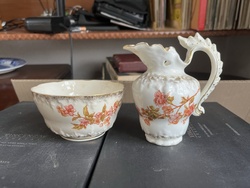
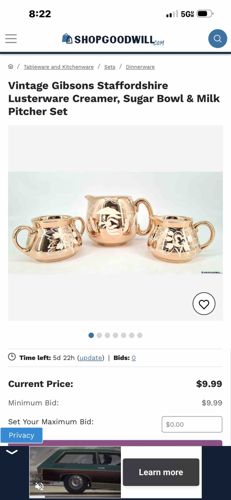
Vintage Gibsons Staffordshire Lusterware Creamer, Sugar Bowl & Milk Pitcher Set

Vintage Ceramic Tableware

AI Estimated Value

·Not an official valuation·Verify before acting

$45 - $75

As of June 8, 2026

AI Item Analysis

·AI can make mistakes·Verify before acting
This is a three-piece vintage ceramic tea service set manufactured by Gibsons in Staffordshire, England, likely dating from the mid-20th century (circa 1940s-1960s). The set includes a central milk pitcher (jug), a twin-handled sugar bowl, and a smaller creamer. Each piece is characterized by a striking metallic copper or rose-gold glaze known as copper luster, which provides a highly reflective, mirror-like finish. The exterior surfaces are adorned with decorative floral and foliate scrollwork patterns that appear to be sand-textured or embossed beneath the luster glaze, creating a three-dimensional contrast. Physically, the pieces exhibit rounded, bulbous bodies with classic C-scroll handles. The craftsmanship is typical of high-quality Staffordshire pottery from this era, combining durable earthenware with decorative metallic finishes. While visible condition appears generally good in the photograph, copper luster of this age is prone to minor surface scratching, 'crazing' in the underlying glaze, and thinning of the metallic finish on high-use areas like handles and rims. The manufacturer's branding, identified in the listing title, suggests a standard Gibsons potter's mark would be present on the underside of each piece. This style of lusterware was highly popular in British households for its ability to mimic more expensive solid metal services.
AI Appraisal Report

·AI can make mistakes·Verify before acting
I have examined the digital representations of this three-piece Gibsons Staffordshire lusterware set. The set exhibits the characteristic copper glaze and 'sand-textured' foliate scrollwork indicative of mid-20th-century English production. Based on visual inspection, the luster retains a high degree of reflectivity, though slight thinning is suspected on the handles and rims—common areas of friction. The forms are consistent with authentic Gibsons molds from the 1940s–1960s. The market for mid-century Staffordshire lusterware is currently stable but saturated. While historically significant as a 'poor man's gold,' these items were mass-produced. Similar three-piece sets by Gibsons or Sadlers frequently appear in the secondary market, keeping the price point accessible for general collectors. The value depends heavily on the absence of 'crazing' (fine cracks in the glaze) and the integrity of the metallic finish, which is easily damaged by modern detergents. Limitations of this appraisal include the inability to check for hairline fractures, chips hidden by the reflective glaze, or to verify the presence of the 'Gibsons England' backstamp. A full authentication would require an in-person tactile inspection, checking for 'ping' resonance to ensure structural integrity, and a microscopic examination of the texture to confirm it is not a later reproduction. Value is maximized when all three pieces remain a 'married' set with consistent wear patterns. This set serves as a fine example of British ceramic history but does not possess the rarity required for high-investment status.

Get your items appraised

Instant estimates of your treasures with AI-powered appraisals

Browse More Appraisals