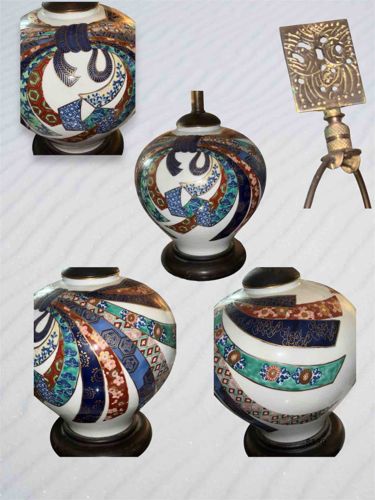
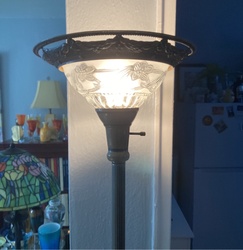
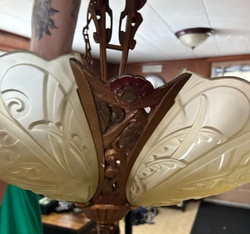
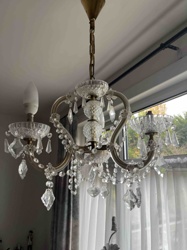
Single round Lamp. Photo is a collage to represent all angles of lamp
These notes were written by the person who submitted this item. Appraiser.AI has not verified them, and the AI's identification and estimate may rely on them.
AI Estimated Value
Not an official valuation
$250-450
AI estimate as of October 19, 2025 · verify with a professional before acting
AI-Generated · Verify before acting
Everything on this page is generated by AI for informational purposes only. AI can make mistakes — the AI may misidentify items or misattribute them (artist, maker, brand, designer, origin, era). This is not an official valuation and should not be used for insurance, sale, tax, estate, legal, or lending purposes — or any decision requiring a certified appraisal. It is not an authoritative claim about any person, brand, or rights holder — do not share or rely on it as a factual statement about a third party. Always consult qualified professionals before making financial decisions.
This analysis also relies on unverified notes provided by the user, which may be incomplete or inaccurate and could affect the result.
This is a single rounded table lamp, crafted from porcelain in the distinctive Japanese Imari style. The lamp base is supported by a dark, possibly wooden, circular plinth. The body of the lamp is primarily white porcelain, serving as a canvas for a vibrant and intricate polychrome decoration. The design features a swirling, ribbon-like motif composed of various geometric and floral patterns in a rich palette of cobalt blue, iron red (or rust), teal green, gold, and understated browns. Some sections exhibit a 'mon' (crest) like design in dark blue, while others showcase more delicate floral or geometric tessellations. The painting appears to be hand-applied with fine brushwork, indicative of quality craftsmanship. The top of the porcelain body is fitted with a metallic finial, likely brass or bronze, which serves as the lamp's electrical fitting. The overall shape is globular or urn-like, typical for decorative table lamps. No significant damage or wear is immediately visible, though a closer inspection would reveal any crazing, chips, or rub marks on the gilded areas. The base appears solid and stable. The style suggests it could be a 20th-century piece, possibly mid to late 20th century, drawing inspiration from traditional Japanese Imari wares that gained popularity in the West. The combination of intricate patterns and the vivid color scheme are hallmarks of this decorative tradition, making it a visually striking and aesthetically pleasing object. The presence of gold accents further suggests a certain level of luxury and attention to detail. The lamp appears to be in good, well-maintained condition.
AI Appraisal Report
Based on my visual examination of the provided image, this Japanese Imari Style Porcelain Table Lamp presents in what appears to be good, well-maintained condition. The intricate polychrome decoration, featuring cobalt blue, iron red, teal green, and gold, is characteristic of the Imari style, suggesting a decorative piece from the 20th century, likely mid to late. The hand-applied brushwork is evident, contributing to its aesthetic appeal. I note the circular dark plinth and metallic finial, which integrate well with the overall design. No significant damage like chips, cracks, or extensive crazing is visible from the image, nor are there obvious rub marks to the gilded areas, which often occurs with use.
Market conditions for 20th-century decorative Imari-style lamps are generally stable, with demand often driven by aesthetic appeal for interior decoration rather than historical significance. Comparable items of this style and period typically fall within the decorative arts market segment. While attractive, Imari-style pieces of this era are not rare. The primary value drivers are its decorative quality, condition, and the perceived craftsmanship. The lack of any apparent damage is a positive factor.
However, I must emphasize the limitations of appraising from images alone. A definitive assessment of authenticity, origin, and condition requires in-person examination. I would need to physically inspect for subtle crazing, hairline cracks, professional repairs, and the quality of the electrical components for safety. Provenance documentation could further verify origin and specific manufacturing period. Without physical inspection or such documentation, while the style is consistent, I cannot definitively authenticate it as a specific period piece or rule out it being a contemporary reproduction. My valuation reflects its decorative merit and condition as observed visually, within the context of the current market for decorative ceramic lighting.