Vintage Japanese Lacquerware Music or Jewelry Box
Antiques & Collectibles - Asian Art & Decorative Arts

Vintage Japanese Lacquerware Music or Jewelry Box

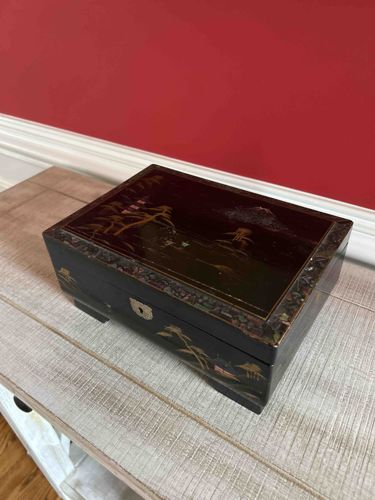
This is a mid-20th-century Japanese lacquerware box, likely dating to the early 1950s (Showa period). Given its provenance as a Korean War veteran's gift, it was almost certainly acquired in Japan during the post-WWII Occupation or Korean War era as a souvenir or 'luxury' export item. The box features a deep black lacquer finish with intricate hand-painted 'maki-e' style gold foliage and mother-of-pearl (raden) shell inlays. The top lid depicts a traditional Japanese landscape featuring a pagoda, pine trees, and a distant Mount Fuji. The central scene is framed by a decorative border of geometric shell mosaic. The front panel includes a metal lock mechanism (key absent) and secondary mountain landscape motifs. Construction is typically of lightweight wood with multiple layers of urushi or synthetic lacquer. Condition shows surface abrasions, minor edge wear, and clouding to the finish consistent with age. There is some visible desiccation or shrinkage in the wood base, common in pieces transitioned from humid to dry climates. This remains a classic example of post-war 'GI souvenir' craftsmanship.
Estimated Value

$125 - $175

Basic Information

Category

Antiques & Collectibles - Asian Art & Decorative Arts

Appraised On

February 24, 2026

Estimated Value

$125 - $175

Additional Details Provided By Owner

User Provided Information

Korean War veteran gift box

Item Description

This is a mid-20th-century Japanese lacquerware box, likely dating to the early 1950s (Showa period). Given its provenance as a Korean War veteran's gift, it was almost certainly acquired in Japan during the post-WWII Occupation or Korean War era as a souvenir or 'luxury' export item. The box features a deep black lacquer finish with intricate hand-painted 'maki-e' style gold foliage and mother-of-pearl (raden) shell inlays. The top lid depicts a traditional Japanese landscape featuring a pagoda, pine trees, and a distant Mount Fuji. The central scene is framed by a decorative border of geometric shell mosaic. The front panel includes a metal lock mechanism (key absent) and secondary mountain landscape motifs. Construction is typically of lightweight wood with multiple layers of urushi or synthetic lacquer. Condition shows surface abrasions, minor edge wear, and clouding to the finish consistent with age. There is some visible desiccation or shrinkage in the wood base, common in pieces transitioned from humid to dry climates. This remains a classic example of post-war 'GI souvenir' craftsmanship.
Get Your Items Appraised

Instant estimates of your treasures with AI-powered instant appraisals

Browse More Appraisals