AI estimate as of October 3, 2025 · verify with a professional before acting
AI-Generated · Verify before acting
Everything on this page is generated by AI for informational purposes only. AI can make mistakes — the AI may misidentify items or misattribute them (artist, maker, brand, designer, origin, era). This is not an official valuation and should not be used for insurance, sale, tax, estate, legal, or lending purposes — or any decision requiring a certified appraisal. It is not an authoritative claim about any person, brand, or rights holder — do not share or rely on it as a factual statement about a third party. Always consult qualified professionals before making financial decisions.
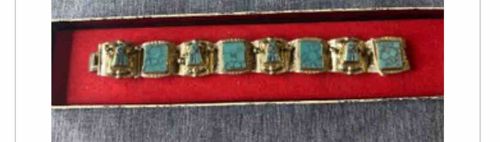
This item is an Egyptian Revival style bracelet, composed of seven linked rectangular panels. Each panel features a central, roughly rectangular turquoise or turquoise-colored stone set within a gold-toned metal frame. The alternating panels (second, fourth, and sixth from the left) also incorporate what appear to be figural elements, possibly stylized depictions of ancient Egyptian deities or symbols, flanking the central stone. The metal appears to be a gold-tone, possibly brass, gilded, or gold-plated base metal, exhibiting some tarnishing and wear consistent with age and handling. The turquoise stones vary slightly in color and matrix, suggesting they might be natural stones, though without closer inspection, it's difficult to confirm if they are solid turquoise, composites, or imitation. The overall construction appears to be machine-made with some hand-finishing, indicated by the uniformity of the links. There are no clear maker's marks or signatures visible in the provided images. The bracelet is displayed in what appears to be its original or a presentation box lined with red velvet or felt, suggesting it was once considered a cherished or gift item. The visible condition includes expected surface wear, minor scratches to the metal, and slight irregularities in the stone settings. The style points to a potential age range from the early to mid-20th century, a period when Egyptian Revival jewelry was popular, especially after archaeological discoveries in Egypt.
AI Appraisal Report
This Egyptian Revival bracelet, featuring seven linked panels with central turquoise or turquoise-colored stones, is a charming example of the style popular in the early to mid-20th century. My visual examination indicates the metal is likely a gold-toned base metal, possibly brass or gilded, exhibiting wear and tarnishing consistent with its age. The alternating panels with figural elements contribute significantly to its Revival aesthetic. The turquoise stones appear to be natural, given the slight variations in color and matrix, but without physical inspection, I cannot confirm if they are solid, composite, or imitation. The overall condition shows expected surface wear and minor irregularities typical of a vintage piece.
Authenticity: Based solely on images, it presents as an authentic period piece of Egyptian Revival jewelry. However, definitive authentication of the metal composition (e.g., gold plating vs. solid gold, type of base metal) and precise identification of the stones (natural vs. treated, composite, or imitation turquoise) would require in-person examination, specific gravity testing, and potentially gemological analysis. The absence of maker's marks is common for this type of costume or semi-fine jewelry from the era.
Market Conditions and Demand: Egyptian Revival jewelry generally enjoys consistent demand, especially pieces that are well-designed and in good condition. Items made predominantly of base metals tend to fall into the costume jewelry category, with values driven more by aesthetic appeal, condition, and collectibility rather than intrinsic material value. Comparisons suggest similar base metal, turquoise-set Egyptian Revival bracelets typically retail in the $100-$300 range, depending on condition and specific design.
Factors Impacting Value: The attractive design and visual condition contribute positively. The primary limiting factor is the likely base metal construction and the unconfirmed nature of the stones. Rarity is moderate, as many such pieces were produced during the Revival period.
To fully authenticate and confirm material composition, I would need to perform a hands-on examination, including scratch tests for metal, magnification to assess stone characteristics, and potentially spectroscopic analysis for definitive stone identification. Provenance documentation, if available, would also add significant value and aid in authentication.