AI estimate as of September 7, 2025 · verify with a professional before acting
AI-Generated · Verify before acting
Everything on this page is generated by AI for informational purposes only. AI can make mistakes — the AI may misidentify items or misattribute them (artist, maker, brand, designer, origin, era). This is not an official valuation and should not be used for insurance, sale, tax, estate, legal, or lending purposes — or any decision requiring a certified appraisal. It is not an authoritative claim about any person, brand, or rights holder — do not share or rely on it as a factual statement about a third party. Always consult qualified professionals before making financial decisions.
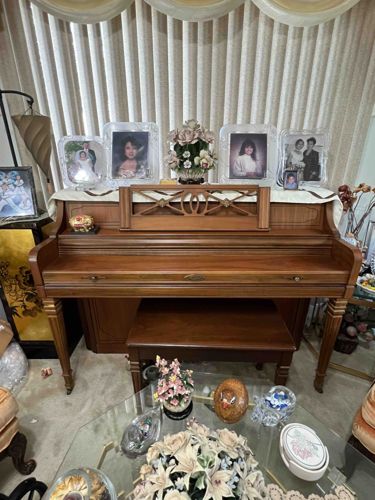
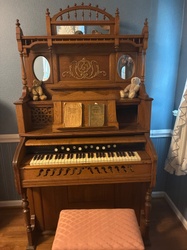
This is an upright piano with a matching piano bench, crafted from what appears to be a medium-toned hardwood, likely walnut or mahogany, with a satin or semi-gloss finish. The piano exhibits classic styling, featuring fluted legs on the front, adorned with brass or gold-toned caps on the upper section and potentially brass ferrules at the feet, though these are partially obscured. The music stand boasts an ornate, carved or fretwork design in the center, characterized by interlocking scroll motifs, adding a decorative touch. The overall construction appears solid and well-made, indicating a reasonable quality instrument. There are no visible major damages such as deep gouges or cracks in the wood, but there might be minor surface scratches or wear consistent with its age and use. The finish shows a degree of patina, suggesting it is not a new instrument, potentially dating from the mid-20th century, perhaps the 1950s to 1970s, based on its design elements and lack of overtly modern features. The piano's overall condition appears to be good for its age, though an internal inspection would be needed to assess the mechanical components, keys, and soundboard. The matching bench is simple in design, providing a cohesive aesthetic. The item is currently used as a display surface, adorned with several framed photographs and floral arrangements.
AI Appraisal Report
Upon visual examination of the provided image, I have assessed this upright piano with its matching bench. The instrument appears to be crafted from a medium-toned hardwood, likely walnut or mahogany, and exhibits a satin or semi-gloss finish. The fluted legs with brass or gold-toned caps, along with the ornate, carved or fretwork music stand, suggest a classic design aesthetic, consistent with a production date ranging from the 1950s to 1970s. The overall construction seems solid, and the wood shows no major damage such as deep gouges or cracks, only minor surface wear and patina typically associated with an item of this age. The matching bench provides a cohesive set.
From a market perspective, demand for older upright pianos has generally softened. While functional, their weight, tuning requirements, and the prevalence of digital alternatives impact their market value. Comparably, similar-era upright pianos in good cosmetic condition often sell for modest sums at auction or private sale.
Key factors impacting value here include the good cosmetic condition and the matching bench. However, the exact make, model, and crucially, the internal mechanical condition (soundboard integrity, pin block, hammer felt, key function, etc.) cannot be determined from imagery alone. These elements are paramount to the playability and intrinsic value of any piano. If the internal components are in poor condition, significant reconditioning costs would be incurred, drastically reducing its 'as is' value.
Authenticity verification from images alone is limited; I can confirm it is an upright piano of the type described. For full authentication and a definitive appraisal, an in-person examination by a qualified piano technician would be essential to assess the internal mechanisms, tuning stability, and overall playability. Provenance documentation, such as original purchase receipts or service records, would also provide a more complete history. Without such an internal inspection, my valuation reflects primarily the appearance and potential as a decorative furniture piece or a piano requiring moderate to significant internal work.