AI estimate as of July 29, 2025 · verify with a professional before acting
AI-Generated · Verify before acting
Everything on this page is generated by AI for informational purposes only. AI can make mistakes — the AI may misidentify items or misattribute them (artist, maker, brand, designer, origin, era). This is not an official valuation and should not be used for insurance, sale, tax, estate, legal, or lending purposes — or any decision requiring a certified appraisal. It is not an authoritative claim about any person, brand, or rights holder — do not share or rely on it as a factual statement about a third party. Always consult qualified professionals before making financial decisions.
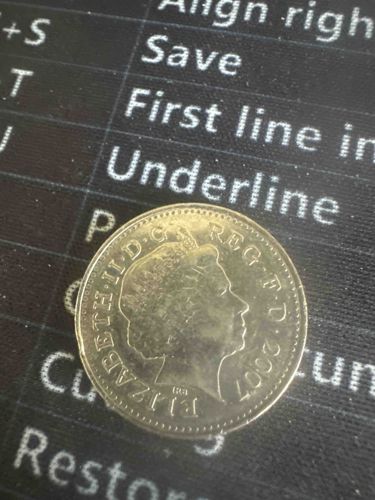
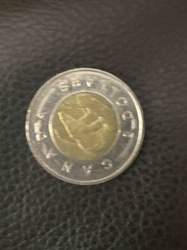
The item is a round, metallic coin, likely made of a brass or nickel-brass alloy, exhibiting a golden-yellow hue, consistent with British coinage from the period. The obverse prominently features a right-facing effigy of Queen Elizabeth II, commonly referred to as the 'Fourth Portrait' or 'Machin Portrait', designed by Ian Rank-Broadley. Around the monarch's head, the inscription reads 'ELIZABETH II D G REG F D 2007', indicating Queen Elizabeth II, by the Grace of God, Queen, Defender of the Faith, and the year of mintage being 2007. The lettering is clear and raised, with a beaded border around the rim of the coin. Small incuse initials 'IRB' for Ian Rank-Broadley are visible below the effigy's neck. The surface of the coin shows considerable wear, consistent with circulation, evidenced by dulling of the original luster and some minor abrasions, particularly on the higher points of the relief, such as the Queen's hair and facial features. There are no pronounced scratches or significant damage, suggesting regular but not excessive use. The edge appears to be milled, although this is not perfectly clear from the image. The overall craftsmanship is typical of mass-produced governmental coinage, with precise details in the engraving. The coin is likely a British 20 pence or a similar denomination due to its size and the visible inscription, aligning with the late 20th to early 21st century period of British currency.
AI Appraisal Report
I have carefully examined the provided image of the British 2007 Coin (Elizabeth II, Fourth Portrait). Based on the visual evidence, the coin appears to be an authentic British issue, likely a 20 pence piece, given the described characteristics and the "Fourth Portrait" of Queen Elizabeth II by Ian Rank-Broadley, which was common on coinage of this period. The inscription 'ELIZABETH II D G REG F D 2007' is clear and consistent with known examples. The small 'IRB' initials are also present, further supporting authenticity.
From the image, the condition of the coin is visibly circulated. There is a noticeable dulling of the original luster and some minor abrasions on the high points of the relief, such as the Queen's hair and facial features, which is consistent with regular use. However, there are no overt signs of significant damage like deep scratches, nicks, or environmental corrosion, suggesting it has been handled with reasonable care despite circulation. The milled edge, while mentioned, cannot be perfectly discerned from the image provided. The craftsmanship appears typical of mass-produced government coinage.
Regarding market conditions, most circulating British coins, especially those from the 21st century, hold little intrinsic numismatic value above their face value unless they are in uncirculated (mint state) condition, possess a rare error, or are made of a precious metal (which this coin is not). The 2007 mintage for the 20 pence coin was extensive, making it a very common issue. Consequently, demand for circulated examples is extremely low among collectors. Its rarity is virtually non-existent.
The primary factor significantly impacting its value is its commonality and circulated condition. Common foreign circulation currency typically sells for very little, often just enough to cover processing or shipping if sold in bulk lots. Individually, its value is negligible.
It is important to state that this appraisal is based solely on visual examination of the provided image. While the features strongly suggest authenticity, full authentication would require in-person examination to verify weight, diameter, thickness, and edge details (such as the milling), which can reveal counterfeits not discernible from a photograph. Additionally, under strong magnification, surface details could be further assessed for tooling or other post-mint alterations. Provenance documentation is generally not applicable or necessary for common modern circulating coinage.