AI estimate as of November 18, 2025 · verify with a professional before acting
AI-Generated · Verify before acting
Everything on this page is generated by AI for informational purposes only. AI can make mistakes — the AI may misidentify items or misattribute them (artist, maker, brand, designer, origin, era). This is not an official valuation and should not be used for insurance, sale, tax, estate, legal, or lending purposes — or any decision requiring a certified appraisal. It is not an authoritative claim about any person, brand, or rights holder — do not share or rely on it as a factual statement about a third party. Always consult qualified professionals before making financial decisions.
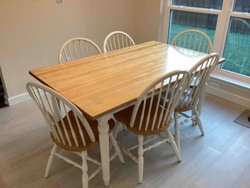
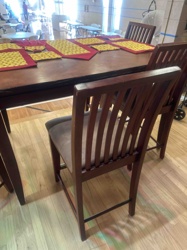
This is a comprehensive dining set comprising a large, rectangular dining table and several matching chairs, indicative of a traditional or possibly classic-revival style. The table features a rich, dark reddish-brown wood finish, likely mahogany or a similarly stained hardwood, with a high-gloss lacquer that reflects the surrounding light. The tabletop displays a distinctive wood grain pattern, possibly burl wood or a veneers arrangement, with a slightly undulating, almost wave-like appearance on its surface. The edges of the table are ornately carved with intricate floral or scrollwork motifs, flowing around its perimeter, and it appears to have a subtle serpentine or scalloped apron. The base of the table is not fully visible but shows dark, heavy carved elements consistent with the overall opulent design. The accompanying chairs are also constructed from the same dark wood, featuring elaborately carved backrests with openwork designs that include scrolls, acanthus leaves, and perhaps a central medallion element. Each chair has a well-padded seat upholstered in a light, neutral-colored fabric, possibly an off-white or beige linen/velvet blend, providing a contrast to the dark wood. The chair legs are also carved, completing the cohesive aesthetic. No visible manufacturing marks or signatures are discernible from the image. The set appears to be in good to very good condition, with a well-maintained finish on the table that shows minimal wear, though closer inspection would be required to identify any minor scratches or dings typical of furniture use. The upholstery seems clean and intact. The craftsmanship suggests a moderately high-quality production, typical of furniture intended for formal dining spaces, likely dating from the late 20th century or early 21st century, designed to evoke historical luxury.
AI Appraisal Report
Upon visual examination of the images provided, this traditional dining table and chair set presents as a high-quality, factory-produced ensemble from the late 20th or early 21st century. The set is crafted from a dark-finished hardwood, possibly mahogany, and features ornate carvings in a classic revival style, including scrollwork, acanthus leaves, and what appears to be a burl wood veneer tabletop. The set, comprising a large table and multiple matching chairs, is in very good cosmetic condition with a high-gloss finish and clean, intact neutral-toned upholstery.
The value is primarily determined by its decorative appeal, size, and perceived quality of craftsmanship rather than antique status or rarity. Current market conditions for large, formal dining sets of this style are somewhat soft, but quality examples still command respectable prices. Comparable new sets of similar mass-produced quality retail for $7,000-$12,000, while secondary market values typically fall within the $2,500-$4,000 range, depending on the manufacturer and local demand. The primary factor influencing this valuation is its excellent visual condition and the completeness of the set.
However, this appraisal is limited by the inability to physically inspect the item. A definitive assessment of the materials (solid wood vs. veneer), construction quality (e.g., joinery), and condition is not possible from images alone. An in-person examination would be required to identify any maker's marks, which would be crucial for determining the manufacturer (e.g., A.R.T. Furniture, Bernhardt, or a similar brand) and refining the value. Without provenance or identifying marks, its origin remains speculative.