AI estimate as of December 10, 2025 · verify with a professional before acting
AI-Generated · Verify before acting
Everything on this page is generated by AI for informational purposes only. AI can make mistakes — the AI may misidentify items or misattribute them (artist, maker, brand, designer, origin, era). This is not an official valuation and should not be used for insurance, sale, tax, estate, legal, or lending purposes — or any decision requiring a certified appraisal. It is not an authoritative claim about any person, brand, or rights holder — do not share or rely on it as a factual statement about a third party. Always consult qualified professionals before making financial decisions.
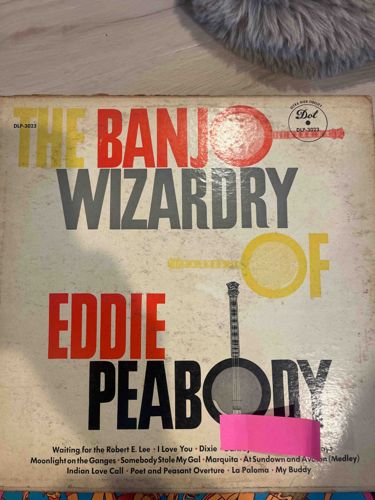
This item is a 12-inch vinyl LP record, featuring "The Banjo Wizardry of Eddie Peabody." The album cover is made of standard cardboard record jacket material and presents a clean, minimalist design with bold, contrasting typography. The title "THE BANJO WIZARDRY OF" is rendered in various colors: 'THE' in yellow, 'BANJO' in red (with a faint red banjo outline), 'WIZARDRY' in dark gray, and 'OF' in yellow. Below this, 'EDDIE' appears in large red letters, and 'PEABODY' in large black letters. A stylized illustration of a banjo in dark gray and white is centrally placed on the cover, partially obscuring the 'O' in 'PEABODY'. The catalog number 'DLP-3033' is visible in the top left corner in yellow text and repeated in a circular emblem in the top right corner, which also states 'ULTRA HIGH FIDELITY' and 'Dol' (presumably the record label, Dot Records). The album features a tracklist at the bottom, including songs like "Waiting for the Robert E. Lee," "I Love You," "Dixie," "Moonlight on the Ganges," "Somebody Stole My Gal," "Marquita," "At Sundown and Avalon (Medley)," "Indian Love Call," "Poet and Peasant Overture," "La Paloma," and "My Buddy." The cover shows some general wear consistent with its age, including slight edge wear and surface scuffs, but no major tears or significant damage are immediately visible, aside from an opaque pink sticker covering a portion of the tracklist. The overall aesthetic suggests a mid-20th-century release, likely from the 1950s or 1960s, reflecting the era's popular music and graphic design trends for album covers. The quality of the printing appears good, with crisp text and vibrant colors despite the age-related wear.
AI Appraisal Report
I have examined the provided image of "The Banjo Wizardry of Eddie Peabody" 12-inch vinyl LP. This appears to be an authentic Dot Records release, catalog number DLP-3033, consistent with mid-century album art and typography. The overall condition of the album cover, from what I can discern, is good for its age, exhibiting general wear such as slight edge wear and surface scuffs, which are expected in a record from the 1950s or 1960s. No major tears or significant damage are visible, though an opaque pink sticker partially obscures the tracklist, which is a minor detraction. The colors remain vibrant and text crisp, indicating good printing quality.
Authenticity is difficult to verify solely from an image. A physical inspection would be needed to verify the vinyl itself, including its condition (scratches, warps), matrix numbers, and label details. Market conditions for Eddie Peabody's records typically place them in the common to moderately collectible category. While he was a celebrated banjoist, his albums are not generally considered rare, nor do they command high prices among audiophiles or collectors compared to first-pressings of rock, jazz, or highly sought-after classical records. Comparables on online marketplaces and record collecting databases suggest similar albums in good condition often sell for modest sums. Factors impacting value here include the good visual condition of the cover, but this is offset by the common nature of the artist and genre, and the presence of the sticker. Without knowing the condition of the vinyl, the value is speculative.
For full authentication and a more precise valuation, I would require an in-person examination of both the sleeve and the vinyl, including assessment for warps, scratches, surface noise, and verification of matrix numbers and label details. Provenance documentation, such as original purchase receipts, would also be beneficial but is rarely available for items of this type.