These notes were written by the person who submitted this item. Appraiser.AI has not verified them, and the AI's identification and estimate may rely on them.
AI Estimated Value
Not an official valuation
$5 - $15
AI estimate as of September 29, 2025 · verify with a professional before acting
AI-Generated · Verify before acting
Everything on this page is generated by AI for informational purposes only. AI can make mistakes — the AI may misidentify items or misattribute them (artist, maker, brand, designer, origin, era). This is not an official valuation and should not be used for insurance, sale, tax, estate, legal, or lending purposes — or any decision requiring a certified appraisal. It is not an authoritative claim about any person, brand, or rights holder — do not share or rely on it as a factual statement about a third party. Always consult qualified professionals before making financial decisions.
This analysis also relies on unverified notes provided by the user, which may be incomplete or inaccurate and could affect the result.
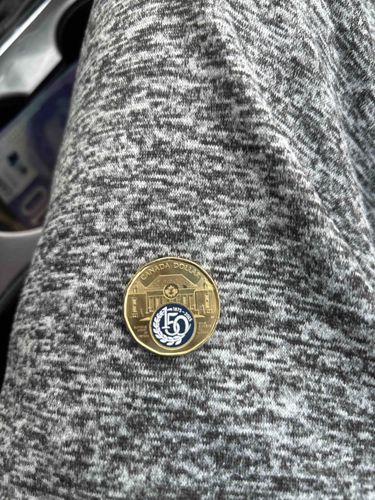
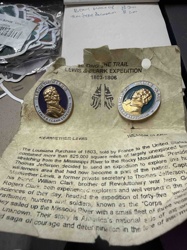
This item is a commemorative lapel pin, designed to resemble a Canadian Loonie (one-dollar coin). It is primarily made of a metallic material with a gold-tone finish, giving it a bright, shiny appearance, though without clear indicators of its exact metal composition. The pin is circular in shape, mimicking the standard dimensions of a Canadian dollar coin.
At its center, the pin features a circular insert with a dark blue background and a silver or white numeral '50' prominently displayed, encircled by a wreath-like design. Below the '50' is smaller text that appears to read '1935-1985', indicating a 50-year anniversary span. Directly above this central blue emblem, a small cross is visible, likely part of a logo or crest, possibly for the Bank of Canada. Above the entire central motif, the words 'CANADA DOLLAR' are embossed in the gold-tone metal. An architectural design, resembling a stately building with pillars (likely the Bank of Canada building), is depicted across the upper half of the pin's gold-tone surface. The pin exhibits a clean, well-preserved condition with no visible scratches, dents, or significant wear, suggesting it has been well-cared for or is relatively new. The craftsmanship appears to be of good quality, with clear detailing on the embossed elements and a smooth, uniform finish. This pin likely dates to around 1985, corresponding to the 50th-anniversary dates visible.
AI Appraisal Report
Upon my examination of the provided image and details, this Canadian Loonie 50th Anniversary of the Bank of Canada Commemorative Pin appears to be in excellent condition. The gold-tone finish is bright and uniform, and I observe no visible scratches, dents, or wear, suggesting it has been well-preserved or is relatively new. The detailing on the embossed elements, such as the 'CANADA DOLLAR' inscription, the Bank of Canada building, and the central '50' with its wreath motif and '1935-1985' dates, is crisp and clear. The craftsmanship appears to be of good quality. Authenticity, based solely on visual inspection of the image, seems high for what it purports to be – a commemorative pin. There are no immediate red flags suggesting a counterfeit, given the nature of the item. This pin commemorates a significant milestone for the Bank of Canada, dating it to around 1985.
From a market perspective, commemorative lapel pins, even those marking historically significant events, generally do not command high values unless they are exceptionally rare, made of precious metals, or linked to a highly sought-after collecting niche. This pin's primary material is described as metallic with a gold-tone finish, not solid gold, which limits its intrinsic value. While a Bank of Canada 50th-anniversary item, it's a mass-produced commemorative, not a limited-edition art piece. Demand for such items is typically modest, appealing mainly to collectors of Canadian memorabilia or banking history. Rarity is not a significant factor here; these types of pins were likely produced in considerable quantities.
Factors impacting value include its excellent condition, clear historical context, and clean design. However, the lack of precious metal content and its nature as a mass-produced promotional item are significant limiting factors. While physical inspection would allow me to determine the exact metal composition (e.g., base metal with gold plating), verify weight, and examine the pin mechanism for quality, given it's a commemorative pin and not a coin of legal tender or a high-value numismatic item, these aspects are less critical for a preliminary appraisal. I cannot definitively verify its authenticity as an official Bank of Canada issue without examining official documentation or comparing it to known authentic examples in person. Based on market comparables for similar commemorative pins of this era and type, the current appraisal value is modest.