AI estimate as of August 10, 2025 · verify with a professional before acting
AI-Generated · Verify before acting
Everything on this page is generated by AI for informational purposes only. AI can make mistakes — the AI may misidentify items or misattribute them (artist, maker, brand, designer, origin, era). This is not an official valuation and should not be used for insurance, sale, tax, estate, legal, or lending purposes — or any decision requiring a certified appraisal. It is not an authoritative claim about any person, brand, or rights holder — do not share or rely on it as a factual statement about a third party. Always consult qualified professionals before making financial decisions.
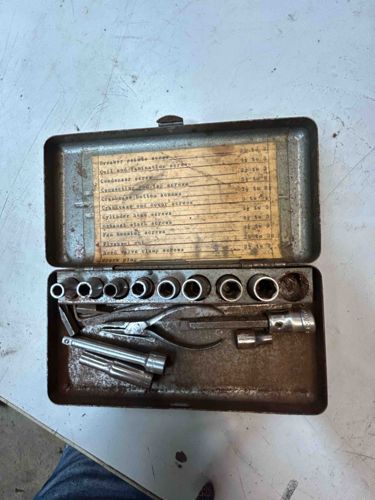
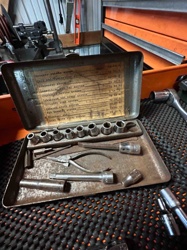
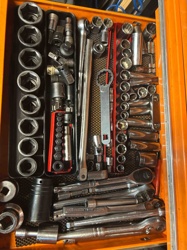
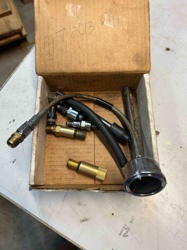
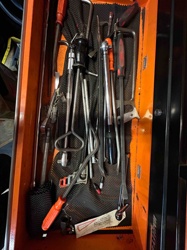
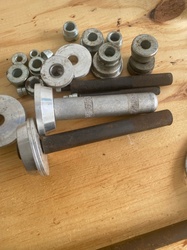
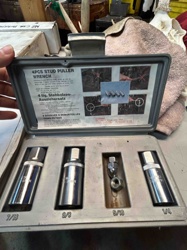
This is a vintage automotive ignition wrench or points tool set, housed within its original metal tin case. The case measures approximately 8-10 inches in length and 4-5 inches in width, made of steel with a dark, possibly blued or painted, finish that has significantly rusted and stained over time, consistent with age and prolonged storage in a workshop environment. The exterior shows heavy surface corrosion, pitting, and discoloration, indicating advanced patina. The interior of the lid features a paper label or decal, now yellowed, brittle, and partially torn, which lists various automotive components (e.g., 'Breaker points screws', 'Quill and Condenser screws', 'Condenser screw') along with corresponding sizes or quantities. This label serves as an inventory guide for the tools once contained within. The set includes a variety of open 'L' shaped ignition wrenches (visible as the elongated, flat tools), a pair of small needle-nose pliers, and a series of approximately 10-12 sockets of varying sizes, ranging from small to medium, arranged in cut-outs along the top edge of the lower tray. Also present are extension bars or handles for the sockets, and what appears to be a breaker bar adapter. The tools themselves, predominantly made of steel, exhibit a dull, aged patina, with some visible surface rust and grease residue, but appear largely intact. The craftsmanship suggests industrial production, with stamped metal components. Based on the style of the tools and the visible text on the internal label, this set likely dates from the mid-20th century, possibly 1930s-1950s, a period when such specialized automotive tool kits were common for vehicle maintenance. The overall condition is fair to poor, due to the heavy corrosion on the case and the general wear on the tools, but its completeness within the original case adds to its historical and collectible value.
AI Appraisal Report
Upon visual examination of the provided image of the vintage automotive ignition wrench and socket tool set in its metal case, I've assessed its condition and potential value. The authenticity appears strong based on the visible style, materials, and the period-correct internal label listing automotive components like 'Breaker points screws' and 'Condenser screw'.
The overall condition is fair to poor. The metal case exhibits significant surface corrosion, pitting, and discoloration, which, while consistent with age and storage, detracts from its aesthetic appeal. The internal paper label is yellowed, brittle, and torn, impacting its legibility. The tools themselves, while largely intact, show dulling, some surface rust, and residue. This heavy patina confirms its age but also indicates advanced deterioration.
In terms of market conditions, vintage automotive tool sets, especially those that are largely complete in their original cases, do have a segment of collectors. Comparables are found in online auctions and specialized antique tool markets. Demand is moderate, driven by automotive enthusiasts, historical collectors, and those restoring vintage vehicles. Rarity for this specific common application tool set isn't exceptionally high, but its completeness in the original marked case adds to its collectibility.
Key factors impacting value are the completeness of the set and the original case, despite its condition. The detailed internal label helps identify its purpose and era, adding historical context. Conversely, the extensive rust and wear on the case and tools significantly limit its value, preventing it from reaching higher collector prices seen for items in very good or excellent condition. Without physical inspection, I cannot confirm tool functionality, absence of hidden damage, or material integrity. Provenance documentation would add to value but is typically unavailable for such utilitarian items. Scientific testing would be necessary for definitive material composition analysis, though not typically performed for this type of appraisal.
Considering the fair to poor condition, but acknowledging its completeness and historical authenticity for its type, I estimate its current market value.