AI Appraisal Estimate

AI-generated estimates · not official valuations

From the user

What was submitted

Photo and notes provided by the user — not generated by AI

Submitted item photo
Submitted photo · June 25, 2026

User's notes

No additional notes provided.

AI analysis below

AI appraisal

AI analysis & estimate

AI-Generated · Verify before acting

Everything below is generated by AI for informational purposes only. AI can make mistakes — the AI may misidentify items or misattribute them (artist, maker, brand, designer, origin, era). This is not an official valuation and should not be used for insurance, sale, tax, estate, legal, or lending purposes — or any decision requiring a certified appraisal. It is not an authoritative claim about any person, brand, or rights holder — do not share or rely on it as a factual statement about a third party. Always consult qualified professionals before making financial decisions.

Read the full disclaimer

AI Identification

·Not independently authenticated·Verify before acting

Cloisonné Floral and Geometric Motif Vase

Decorative Arts

AI Estimated Value

·Not an official valuation·Verify before acting

$150-250

As of June 25, 2026

AI Item Analysis

·AI can make mistakes·Verify before acting
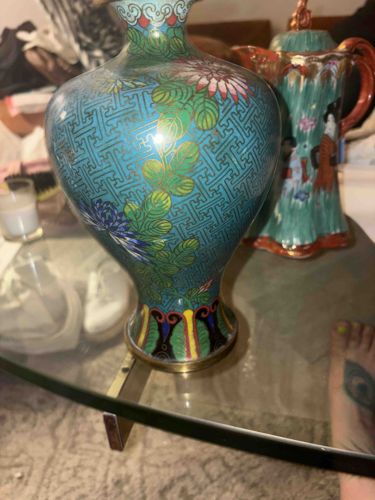
This item is a vase crafted in the traditional cloisonné technique, characterized by its vibrant enamel work applied within cells formed by thin metal wires. The vase features a bulbous body that tapers towards a flared neck and a subtly footed base. The primary background color is a striking teal blue, adorned with an intricate, repeating geometric pattern resembling a key pattern or fretwork, rendered in a slightly darker blue or green. Overlaid upon this geometric ground are various floral motifs, including large chrysanthemum-like blossoms in shades of pink, purple, and white, accompanied by lush green leaves. The neck of the vase displays a stylized floral border in light blue, red, and green. The base of the vase exhibits a more elaborate decorative band with alternating abstract forms in yellow, red, green, and dark blue, outlined by the thin brass or copper wire cloisons. The rim of the neck and the base appear to be finished with a polished brass or gold-toned metal band. The surface of the enamel shows some signs of wear, including minor scuffs and possibly some light surface oxidation or patina on the metal elements, consistent with age and handling. The craftsmanship appears to be of good quality, with precise wirework and smooth enamel application, indicating a well-executed piece typical of Chinese cloisonné. Based on the style and typical production methods, it likely dates from the mid-20th century.
AI Appraisal Report

·AI can make mistakes·Verify before acting
Upon visual examination of the images provided, this cloisonné vase presents as a well-crafted decorative object. The piece features a vibrant teal blue background with a geometric key-pattern ground, overlaid with colorful floral motifs, characteristic of Chinese cloisonné work. The quality of the wirework and the smooth application of the enamel suggest competent craftsmanship. The condition appears to be good, with minor surface scuffs and some patina on the metalwork consistent with its likely age, which I estimate to be mid-20th century based on its stylistic attributes. The market for mid-century Chinese cloisonné is generally stable, but pieces from this era are quite common. The value is primarily decorative rather than antique. Comparables for similar mid-20th-century vases of this size and quality typically sell in the low hundreds. Factors keeping the value in this range include its likely 20th-century origin (as opposed to an earlier, more valuable period like the Qing Dynasty), the commonality of the form, and the visible signs of wear. Limitations: This appraisal is based solely on images. An in-person examination is crucial to fully assess the condition, such as checking for internal damage, enamel repairs, or hairline cracks not visible in photos. Full authentication would require inspecting the base for maker's marks or reign marks, evaluating the weight and quality of the metal, and potentially X-ray fluorescence (XRF) analysis to confirm the metal composition and enamel pigments are consistent with the proposed period. Provenance documentation would be necessary to link it to a specific workshop or historical context.

Get your items appraised

Instant estimates of your treasures with AI-powered appraisals

Browse More Appraisals