AI estimate as of July 5, 2025 · verify with a professional before acting
AI-Generated · Verify before acting
Everything on this page is generated by AI for informational purposes only. AI can make mistakes — the AI may misidentify items or misattribute them (artist, maker, brand, designer, origin, era). This is not an official valuation and should not be used for insurance, sale, tax, estate, legal, or lending purposes — or any decision requiring a certified appraisal. It is not an authoritative claim about any person, brand, or rights holder — do not share or rely on it as a factual statement about a third party. Always consult qualified professionals before making financial decisions.
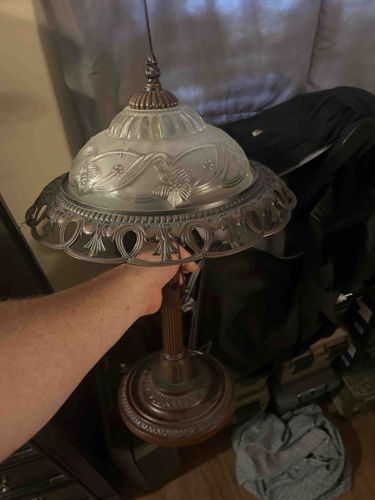
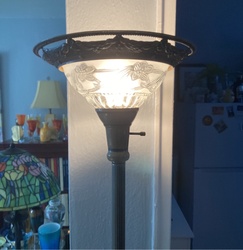
This is an antique or vintage-style table lamp, likely made in the early to mid-20th century, possibly in the Art Nouveau or Art Deco style given its decorative elements. The lamp features a prominent dome-shaped glass shade that appears to be frosted or etched with a floral and ribbon motif, showing good craftsmanship in its detailed pattern. Above the glass shade, there is a decorative metal finial with a ribbed or fluted design, and below the glass shade, a robust decorative metal rim or skirt is present. This rim is intricately designed with interconnected loops and possibly other scrolled elements, exhibiting an oxidized or bronzed finish, suggesting brass or a similar alloy that has developed a rich patina over time. The base of the lamp is substantial and round, also made of metal with a matching finish, featuring embossed or cast patterns, including a fluted design around its perimeter. The central stem of the lamp appears to be fluted or ribbed, connecting the base to the shade assembly. The overall color scheme is predominantly dark brown/bronze for the metal components and a translucent, light milky white for the glass shade. The condition appears to be good for its age, with no obvious major damage like cracks in the glass or significant dents in the metal, though typical wear and patina consistent with age are observable, contributing to its antique aesthetic. The construction indicates a cast metal manufacturing process for the base and decorative elements.
AI Appraisal Report
Based on my visual examination of the provided image, this Art Nouveau/Art Deco style table lamp appears to be a good example of early to mid-20th-century decorative lighting. The condition appears to be very good for its age, showing typical patina and wear consistent with a vintage item, but no obvious chips, cracks to the glass, or significant dents to the metal. The intricate casting of the metal base and shade rim, coupled with the detailed frosted glass shade, points to quality craftsmanship typical of the period. The style elements, particularly the floral and ribbon motifs on the glass and the organic, flowing lines of the metalwork, align well with both late Art Nouveau and early Art Deco aesthetics, making it a versatile piece.
In terms of market conditions, there is consistent demand for authentic period lighting, especially pieces that blend well with various decorative styles. Comparable sales for well-preserved Art Nouveau or Art Deco table lamps of similar scale and complexity typically fall within the '$600-$1,200' range, with exceptional pieces fetching more. This lamp's appeal lies in its decorative quality, good condition, and the elegant contrast between the aged bronze-tone metal and the frosted glass. While not extremely rare, well-maintained examples like this are desirable.
Limitations to authenticity verification from images alone are significant. I cannot definitively confirm the material composition (e.g., specific alloy of the metal), the exact age, or the manufacturing origin without in-person examination. A physical inspection would allow me to check for manufacturer's marks, assess the integrity of the wiring (crucial for safety and operational value), and detect any subtle repairs or restorations not visible in the photograph. Furthermore, provenance documentation, such as original sales receipts or family histories, would significantly enhance the authentication process and could potentially increase its value. Scientific testing, such as material analysis, would confirm the metal composition.